|
|
If a micro-SaaS pricing page gets 400 visitors a month and converts at 1.2%, that’s about five customers. Move it to 2%, and you’re at eight. Three extra customers at this stage is a 60% revenue lift — without shipping new features or increasing marketing spend.
Many micro-SaaS founders treat pricing as a revenue problem. They add tiers and options, assuming a complex pricing page signals a serious product.
But at low traffic, that assumption costs you customers. Every visitor who lands on a confusing pricing page and leaves is one you can’t replace with volume.
We’ve seen this play out across thousands of software products. The ones that convert best at low traffic share the same pattern:
- No more than three tiers
- An accessible entry tier
- Instantly understandable pricing
This article breaks down why that works, drawing on real pricing experiments from founders to show you what to fix first.
How Pricing Psychology Changes When You’re Under 1,000 Users
Unlike enterprise SaaS pricing that’s optimized for large contracts and expansion revenue, micro-SaaS pricing has one job: get more people to say “yes”.
Enterprise companies can afford complex pricing because they have brand equity and sales teams to explain the value during a structured buying process.
As micro-SaaS products operate without this, any point of confusion on a pricing page leads to immediate abandonment.
Adam Yong, founder and CEO of BrandPeek and Agility Writer, experienced this with fewer than 500 customers. He launched with three fixed tiers starting at $25/month, usage caps, and flat billing.
“I was losing sales because I gave users too many choices. Most visitors weren’t clicking anything before leaving, and support tickets were full of the same feature questions like Which plan do I need? What’s included in each tier? Why are these limits different?”
After removing the middle tier, simplifying usage limits, and eliminating fees that appeared at checkout:
- Abandoned carts dropped 22% in the first two weeks
- Billing-related support tickets dropped by roughly a third
Pricing is also a trust signal. Companies like Notion and Stripe can afford complexity because visitors arrive already trusting the product. Your visitors, however, are still making up their minds and your pricing page is there to help them decide.
Pro tip: Before changing anything on your pricing page, ask yourself: does this remove a reason not to buy, or does it add one?
Why $9–$29 Works Psychologically When Other Prices Don’t
The $9–$29 price band sits below most approval thresholds and matches familiar subscription prices. This range triggers three psychological drivers:
- It stays below the limit for company card sign-offs.
- It anchors to familiar costs like Netflix or Spotify.
- It feels like “trying” rather than “committing.”
Koalendar, a scheduling platform, priced their Pro tier at $9.99/seat/month. The low entry point drove volume, and 22%–28% of early Pro users expanded to multi-seat or Teams plans within nine months.
“Churn was higher compared to higher entries ($29–$49) in past projects, but with lower decision friction, conversion improved 40%–60%, which mattered more at that stage,” shares Head of Marketing and Sales Rubén Medina.
On the other hand, a TikTok Shop compliance monitoring tool, SellerOps, started at $29/month. For customers making $50,000 to $200,000 per month, a single late dispatch violation costs $500–$2,000. At $29/month, prevention is a no-brainer.
“We deliberately avoided a low first tier because we didn’t want to attract hobbyist sellers who’d churn in 30 days. At $29 we’re attracting people who already understand the cost of non-compliance and see monitoring as a business expense, not an experiment,” says founder Kris.
How to Choose The Right First Tier
The right entry price depends on your revenue model and who you’re trying to attract.
| Lower entry | Higher entry | |
| When it works | Revenue depends on users expanding into higher-value plans | Product prevents a measurable loss or generates direct revenue |
| Who it attracts | Higher volume, more price-sensitive users | Smaller volume, higher-intent users |
| Risk | High churn if users never expand | Low conversion if the ROI isn’t obvious |
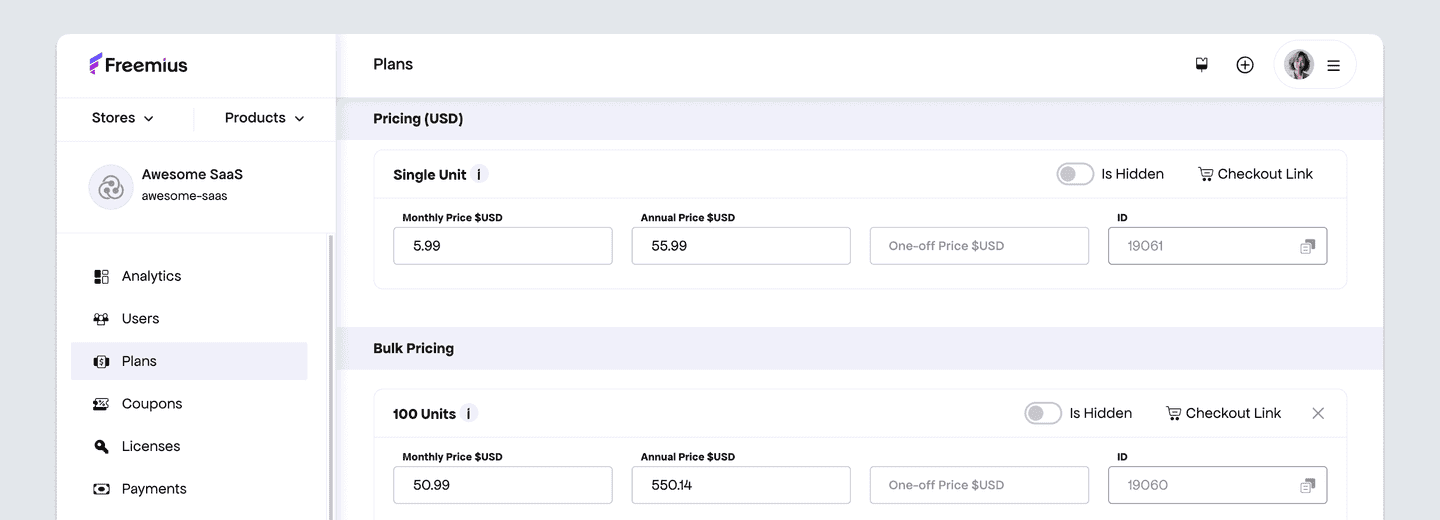
The right entry tier often becomes clear only after you see how real users respond. With Freemius, you can test that quickly — just open your Developer Dashboard, go to Plans, adjust the price of the tier, and publish the change in seconds.
Choosing the right entry price removes one layer of friction. The next mistake many founders make is introducing a pricing model that adds it right back.
Why Usage-Based Pricing Can Add Friction Early
If users have to calculate their bill based on credits, API calls, or projects, many will simply close the tab.
Hamid Ali, founder and CEO of WordLayouts.com, tested usage-based pricing and abandoned it after six weeks.
Customers couldn’t estimate usage for complex projects, which created fear of runaway charges, so they canceled before hitting their limits.
Abhishek Shah, founder of Testlify, ran the same experiment and rolled it back within three months.
“Users didn’t like the cognitive overhead of forecasting their usage even when bills weren’t dramatically higher.”
For most products under 1,000 users with predictable usage, a flat tier that covers the typical customer’s usage range is enough. If your heaviest users represent a small fraction of your base and their usage doesn’t meaningfully affect your costs, flat pricing is the right call.
When usage genuinely varies and your heavy users do create real cost differences, a hybrid model is a cleaner compromise than pure usage billing.
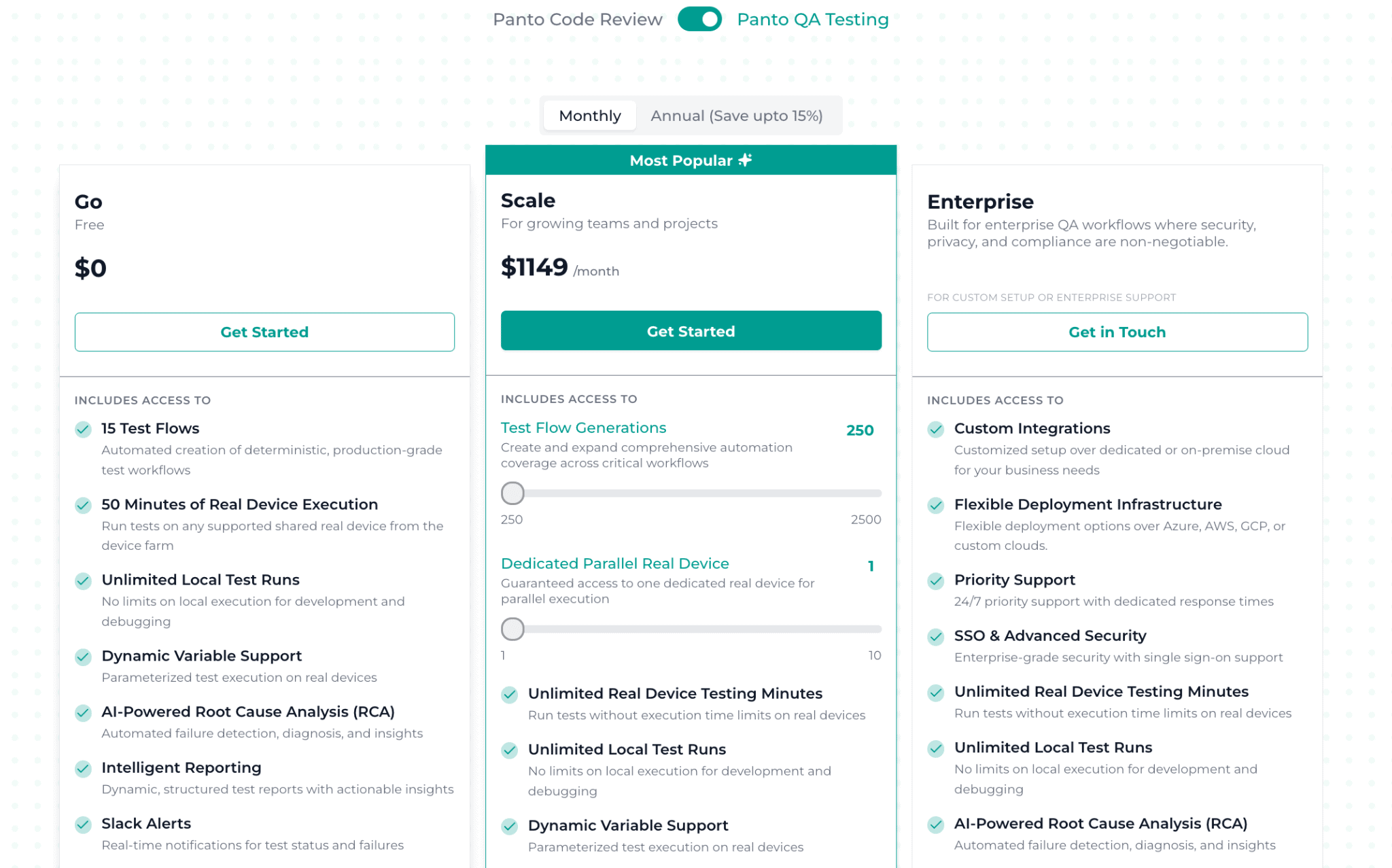
Pavankumar Kamat, co-founder and CEO of Panto AI, landed here after testing both. Because pure usage billing confused 10%–15% of new customers and spiked billing support tickets, he introduced:
- A base fee covering typical usage
- A simple bill estimator
- A hard overage cap
The result:
- Billing support tickets dropped 40%
- Monthly churn fell 20%
Pro tip: Add usage-based pricing when retained customers ask for it because their usage has genuinely outgrown your flat tiers. Using it as a conversion strategy rather than a retention and expansion tool adds friction at the worst possible moment.
The next question is how much commitment you should ask for upfront.
The Right Time to Introduce Annual Pricing
Our recent state of micro-SaaS report shows annual plans cut churn by 30% and increase customer lifetime value by 27%. Every founder who introduced annual billing saw meaningful results, but those results came after the product had established retention.
Asking a first-time visitor to commit to 12 months assumes trust that hasn’t been built yet.
Hamid introduced annual pricing with a 2-month discount around the 400-customer mark, about six months in.
Monthly churn for customers who switched to annual dropped from 8% to under 3%. As for those who explicitly chose monthly over the pre-selected annual, 70% churned within 90 days.
Pavankumar introduced annual after reaching product stability and saw similar results:
- 20%–25% of signups converted to annual
- Churn for that cohort dropped 30%
As a good counterexample, Koalendar offered annual from launch, but monthly was always the default.
Both options appeared side by side with a clear “Save 30%” badge, and customers were never pushed away from monthly.
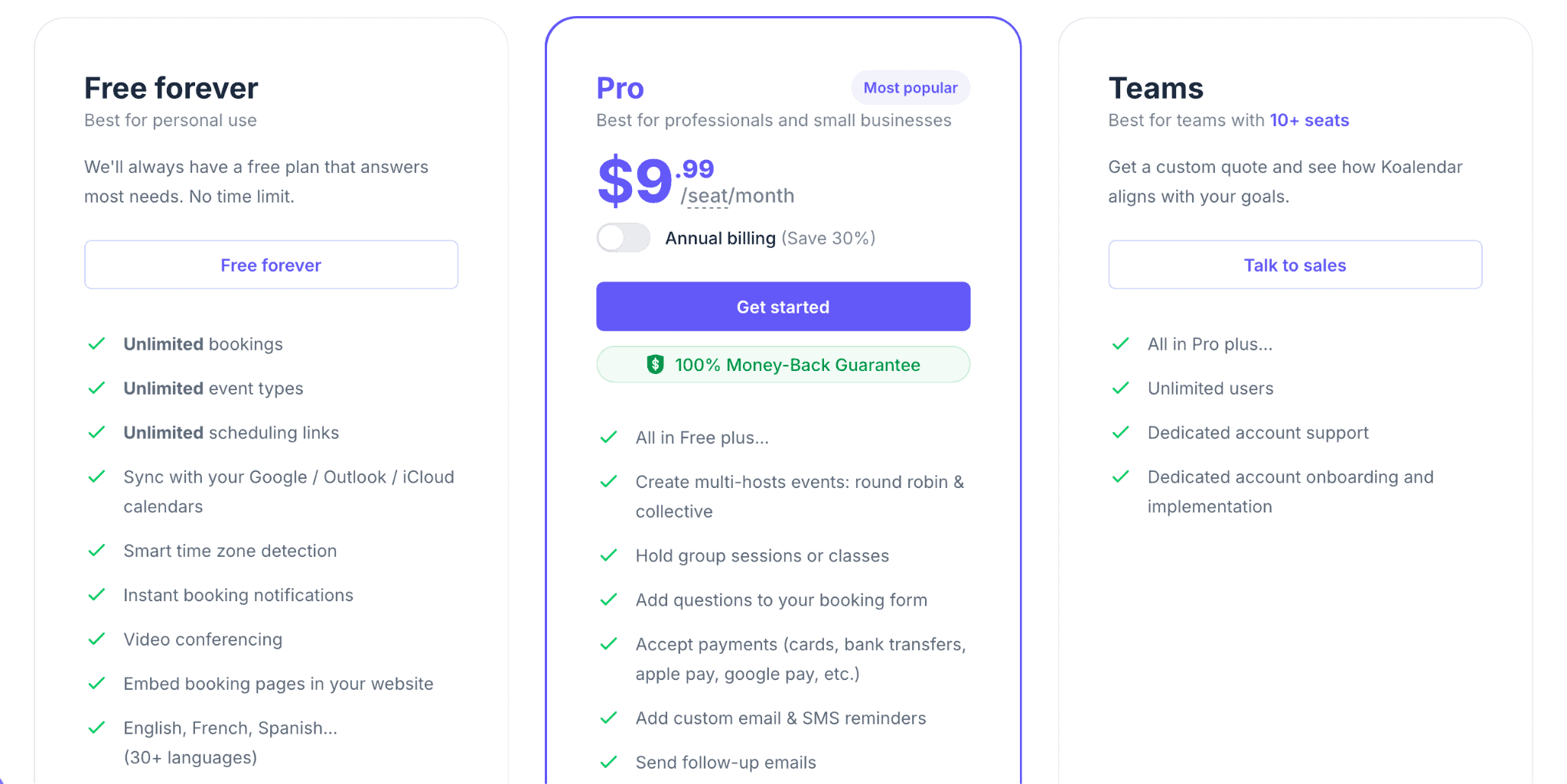
“The result was flat-to-positive conversion impact, with 18%–26% choosing annual and no drop in top-of-funnel signups,” shares Rubén.
Three rules for introducing annual pricing:
- Offer annual billing alongside the monthly option.
- Default to monthly and present annual as an upgrade for customers who already plan to stay (not as a lock-in mechanism for those who aren’t sure).
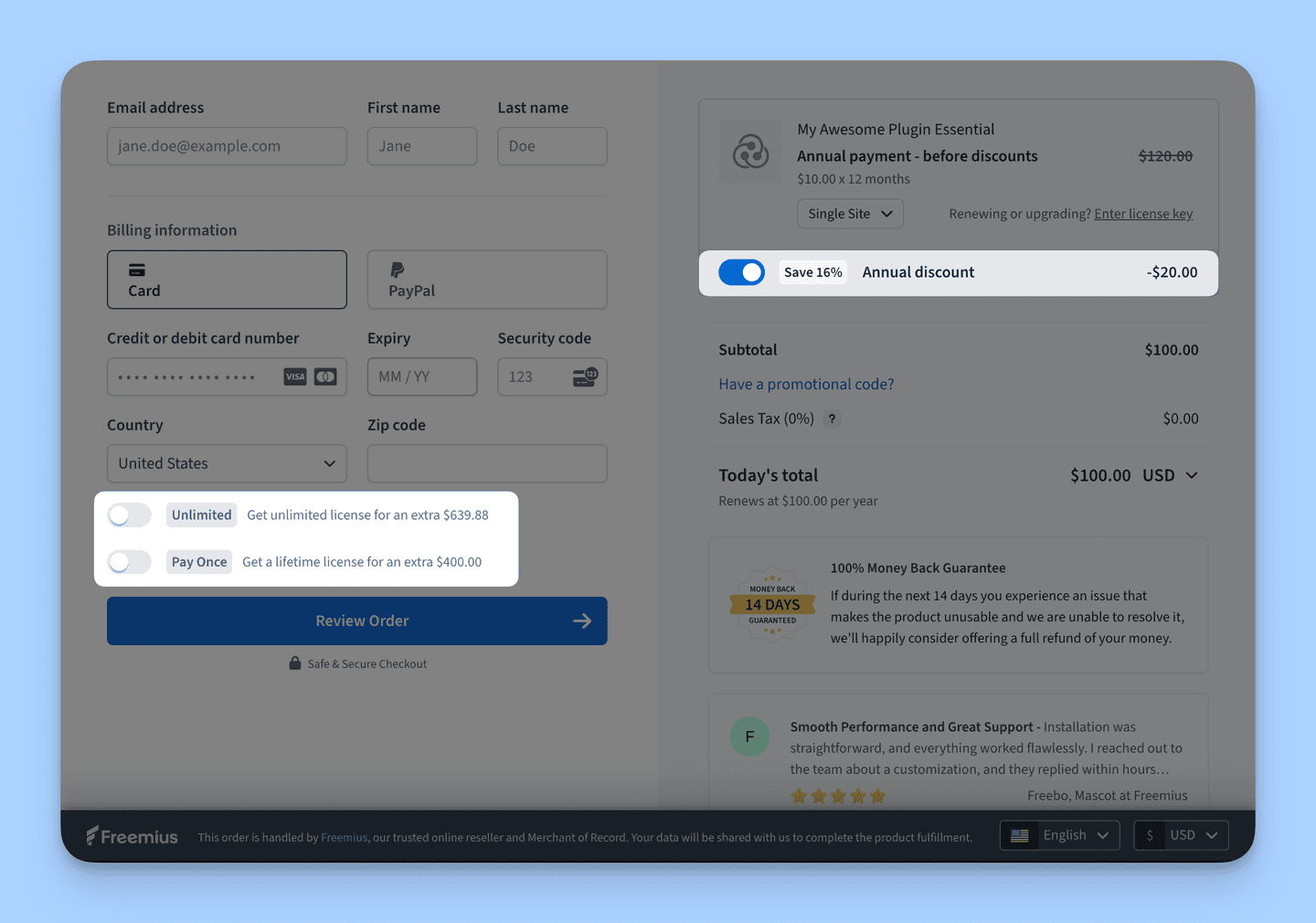
- Two months free (roughly 16% discount) is the standard incentive. Frame it as a perk, not a discount.
In Freemius, you simply enable annual billing for a tier and display it next to the monthly option.
Pro tip: Avoid defaulting to annual-only pricing before product-market fit as a retention fix. It traps customers who aren’t yet convinced, and that group will request refunds and write negative reviews at higher rates than customers who simply churned on monthly.
What is the Right Number of Micro-SaaS Pricing Tiers?
More tiers can feel like more value to a founder. But to a visitor trying to make a quick decision, they feel like homework. When every option requires comparison, the safest decision is no decision at all.
The ideal structure for most micro-SaaS products under 1,000 users is:
- Starter: An entry point low enough to validate the use case
- Pro: The target tier where most users should land
- Business (optional): For teams or power users who ask for higher limits
Testlify’s original pricing had three tiers at $19, $49, and $99, with feature gates that “made sense only to them.”
The tiers had small incremental differences rather than clear value jumps, which forced visitors to compare rows in a pricing table instead of immediately recognizing where they belonged.
After simplifying to two tiers with clear limits and raising the entry plan to $29, revenue per user increased 40% and monthly churn dropped from over 12% to below 8%.
Pavankumar had the same experience. Three paid tiers, 400–800 monthly visitors, and trial-to-paid conversion stuck at 1.0%–1.5%.
After cutting to two tiers with clear usage caps, raising the entry price from $9 to $19, and adding a bill estimator:
- Trial-to-paid conversion rose to 2.8%
- Average revenue per user increased 35%
Cutting tiers was only half the fix. The other half was making the remaining tiers easy to choose between.
Most visitors landing on your pricing page don’t know your product well enough to know if they need “advanced reporting” or “priority support.” But they do know if they have 3 team members or 15. Build your tiers around that.
The Billing Infrastructure Behind Every Pricing Decision
Every founder in this article changed their pricing at least once. The ones who did it without losing customers or stalling their product weren’t dependent on engineering to make it happen.
The best pricing decision you can make early is building a setup where changing it is low-cost.
Real pricing flexibility means:
- Tier structures and price points can be tested without touching code
- Monthly and annual billing run in parallel, or annual can be added later without rebuilding
- Customers who upgrade or downgrade are prorated automatically, without support tickets
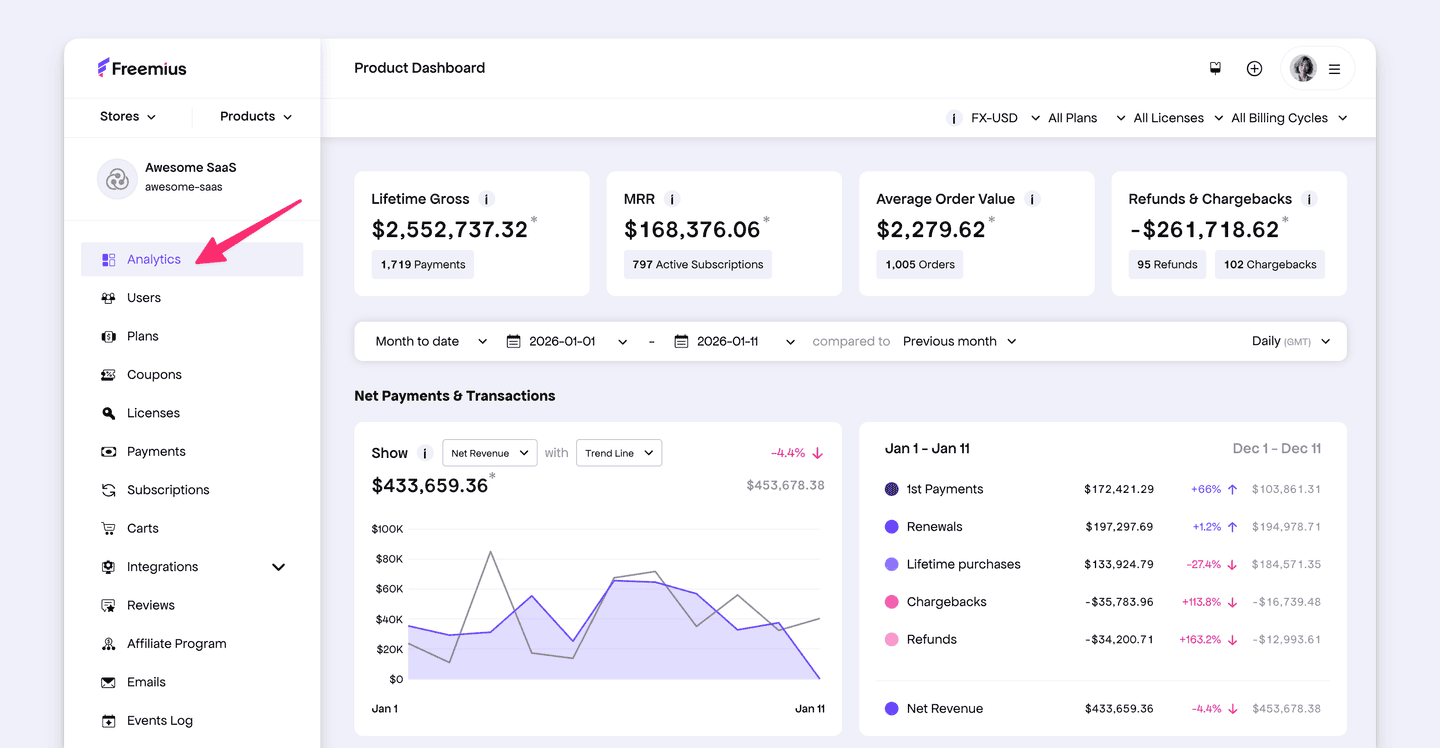
- Retention data is tied to pricing tiers, so you can see which plans drive long-term revenue, not just which ones convert
This is exactly what Freemius is built for. Acting as the billing layer so pricing stays a product decision, not an engineering one. As a merchant of record, it also handles subscriptions, proration, tax compliance, and revenue analytics in one system.
The founders who get pricing right are willing to iterate consistently. The infrastructure needs to support that.
But before you change prices, first figure out what’s stopping people from buying.
The Pricing Audit Most Micro-SaaS Founders Skip
Run through these five questions before you touch anything:
- Can a visitor understand your pricing in under 10 seconds?
Read your pricing page as if you’ve never seen your product. If you need to re-read anything to understand what’s included, a new visitor will just leave. - Does the first tier feel like “trying” or “committing”?
If someone has to calculate whether it’s worth it before clicking, the entry point is creating hesitation. It should feel like a low-risk experiment, not a decision. - Is the upgrade path obvious?
A visitor should see how to grow before they need to. If users only find the Pro tier after hitting a limit on Starter, you’re losing upgrades that would have happened naturally. - What is your pricing page conversion rate?
A common range for pricing-page-to-paid conversion is 2%–4%, though it varies depending on trial vs freemium models. If you’re below 1%, something on the page is confusing people and it’s usually not the price itself. - Where are you doing things manually?
If a pricing change means exporting users, updating plans one by one, or handling upgrade requests manually, your billing setup is slowing you down. You’ll stop iterating on pricing simply because it’s too complicated or time-consuming.
The answers will tell you exactly where to start.
The Shortest Path to Better Conversion
The founders in this article won by removing every reason a visitor might not buy.
If you’re not sure where to start, here are a few options:
- If you have more than three tiers, remove the ones that don’t have clear, different use cases
- If your entry tier is above $29 and you can’t point to a specific cost it saves or revenue it generates, lower it
- If customers regularly contact support asking what’s included in each plan, rewrite your tier descriptions around limits, not features
- If customers reach their plan limit but don’t upgrade, add an in-app prompt at the moment they hit it
- If updating your pricing requires manually adjusting billing for existing customers, fix your billing setup before your next price change
If you want a second pair of eyes on your pricing, book a discovery call with our CEO Vova Feldman — he’ll help you figure out where to start.
Once your tiers are clear and your billing handles changes automatically, pricing decisions become something you test rather than agonize over.
FAQ
Is a low first tier attracting the wrong customers?
If your cheapest plan has high signup volume but low upgrade rates and high support load, it probably is. But the fix isn’t always raising the price. Sometimes it’s better to strengthen what the next tier offers so the gap feels worth crossing.
How do I raise prices without losing existing customers?
Grandfather existing customers at their current price and apply the new pricing only to new subscriptions. It may feel uncomfortable, but most customers won’t churn over a price increase they never experience. When you’re ready to migrate them, give enough notice, explain the reason, and offer a transition period.
Should I offer a free plan or a free trial?
A free trial gives you paying customers faster and filters out low-intent users. A free plan can build a larger top of the funnel, but only works if there’s a clear, natural trigger that pushes free users to upgrade. If you can’t name that trigger, start with a trial.
When does usage-based pricing actually make sense for a small product?
When retained customers tell you their usage has outgrown your flat tiers and they’re hitting limits your current plans don’t cover.
How do I decide what features go in each tier?
Put the feature that solves the core problem in your entry tier. The features that scale with growth, such as more users, more volume, more integrations go in Pro. If you’re not sure what those are, look at what your best customers use most.
How do I know if a pricing change is working?
Track pricing page conversion rate, trial-to-paid conversion rate, and churn by plan before and after the change. Give it at least one full billing cycle before drawing conclusions. If all three improve, the change worked.