

Setup Recommended Refund Policy for your SaaS or App
You can tailor the refund policy for your SaaS or App products sold through Freemius to help build trust with your customers and reduce purchase anxiety.
The refund policy settings are accessible via the Plans page. Click the Refund Policy tab to reveal the settings.
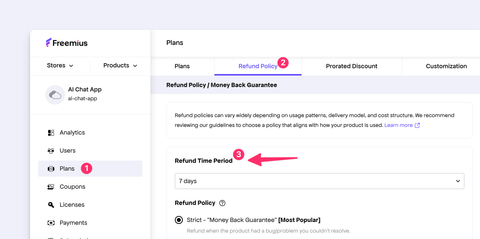
To learn more about the available refund policy options visit our Refund Policy Guide.
Here are our recommendations for your product:
For SaaS Makers
Refund policies for SaaS should reflect how and when value is delivered, as well as whether the usage has a real, irreversible cost.
Traditional SaaS (Low or No Usage-based Costs)
Examples include analytics tools, form builders, CRMs, subscription apps, and other services where user activity does not meaningfully increase your operating costs.
For these products, we generally recommend offering a money-back guarantee of 14 to 30 days. This aligns with common SaaS buyer expectations, reduces purchase hesitation, and typically results in higher conversion rates with limited abuse.
The exact refund period should be determined by how quickly new users can realistically experience value. Simpler, self-serve products can often use a shorter window, while more complex tools may benefit from a longer one. Refunds are typically limited to the first billing cycle.
SaaS with Ongoing, Usage-based Features
These include AI-assisted tools, chatbots, monitoring services, or platforms where value accumulates over time and depends on continued use.
In these cases, a shorter money-back guarantee refund window of 7 to 14 days can still be effective, especially when paired with clear usage boundaries. Many makers choose to limit refunds to unused credits only, or make refunds conditional on reasonable usage during the refund period.
This approach helps maintain buyer confidence while protecting the business from excessive or abusive usage.
SaaS with One-off or Consumptive Usage
Examples include AI content generation, video or image processing, data exports, or any service where value is delivered instantly and cannot be undone.
For these products, we generally do not recommend offering refunds for consumed usage. Once the service has been used and the output has been delivered, it is difficult to prevent abuse.
Instead of refunds, consider offering:
- A free preview or limited free tier
- Watermarked or partial outputs
- A small amount of trial credits
If a refund policy is offered at all, it should be limited to unused credits only, and clearly state that no refunds are available once usage has occurred.
For App Makers (Downloadable Software)
This category includes desktop and mobile applications that are downloaded and installed locally, such as macOS, Windows, or Linux apps, as well as packaged mobile apps sold outside of app stores.
For most downloadable apps, we generally recommend offering a limited money-back guarantee of 7 to 14 days. This gives users enough time to install the app, test compatibility with their system, and evaluate core functionality, while keeping the refund window short enough to reduce abuse.
That said, refunds may not be appropriate for apps that:
- Deliver their full value immediately upon download or first use
- Are designed for one-time or short-term use
- Allow easy copying, exporting, or offline reuse after installation
Examples include license unlockers, media conversion tools, utilities with instant output, or software where continued access does not depend on an ongoing service.
In such cases, many app makers choose a no-refund policy and instead rely on:
- Free trials or feature-limited demo versions
- Watermarked exports or restricted functionality
- Clear system requirements and preview materials
This approach helps set expectations upfront while minimizing the risk of refund abuse.
In the event, the buyer disputes a charge, see how we handle disputes and chargebacks.