|
|
You pick a payment platform, integrate it, and ship. Then you find out your product violates their acceptable use policy.
Payment platform restrictions for AI apps are one of the most overlooked risks when choosing a billing provider. Switching mid-integration can cost weeks of dev time and a portion of your active subscribers.
To understand why these restrictions vary so much between platforms, it helps to understand who carries the legal risk.
Merchant of record platforms — like Freemius, Paddle, and Lemon Squeezy — are the legal sellers of your product. They carry the tax and compliance burden, which means they also control what gets sold through their checkout. For AI products, where the output itself can carry legal risk, that liability translates directly into category restrictions.
Paddle, for example, explicitly prohibits AI image generators, deepfake tools, and voice cloning products.
Payment processors like Stripe carry less liability because you remain the legal seller, which means fewer category restrictions, but full tax and compliance responsibility shifts to you.
We reviewed the actual acceptable use policies so you don’t have to guess. This article breaks down payment platform restrictions for AI apps, including which platforms are likely to accept your product, what they look at during review, and what to do if you get rejected.
TL;DR: Payment platform restrictions for AI apps
- Your app generates images, deepfakes, or voice content → Paddle’s AUP explicitly prohibits these categories. Don’t integrate before confirming compatibility with their team.
- Your app uses AI as a feature, not the output → Any platform works. An AI-powered code editor or writing assistant clears review on every major platform.
- You want case-by-case review instead of category-level bans → Freemius evaluates products individually based on function and compliance profile, not on whether AI keywords appear in your listing.
- You’re shipping fast on a tight timeline → Lemon Squeezy flags AI keywords for manual review. Build at least 2–5 business days into your launch timeline before you can accept payments — longer delays are possible.
- You need maximum product category flexibility → Stripe doesn’t restrict AI as a category, but you own all tax collection, VAT filing, and compliance obligations across every market where you sell.
AI app payment platform restrictions at a glance
| Platform | AI product policy | Tax handling | Typical review timeline |
| Paddle | Explicitly prohibits AI image generators, deepfake tools, and voice cloning | MoR (handled) | 1–3 weeks for AI products flagged for extended review |
| Lemon Squeezy | No AI-specific prohibitions, but AI keywords trigger manual review | MoR (handled) | 1–5 business days standard; can extend to several weeks |
| Stripe | No AI-specific restrictions; restricted list targets card-network-prohibited categories | You handle it | Under 48 hours in most cases |
| Freemius | Reviewed per product on function and compliance profile; no blanket AI restrictions | MoR (handled) | Under 24 hours for standard products; ~5 business days if additional review required |
What Paddle’s AUP actually prohibits for AI products
Paddle draws the hardest line of the four platforms, naming specific AI categories as outright prohibited. Not restricted or gray-area — prohibited.
Before you write a single line of integration code, confirm your product doesn’t fall into one of them:
- AI-generated images: Tools whose primary output is AI-created visual content
- Deepfake technology: Any product that generates or manipulates realistic human likenesses
- Voice impersonation: Tools that clone or simulate human voices
What Paddle generally allows are AI-assisted tools where the AI augments a human workflow rather than producing the end deliverable. A code editor with AI autocomplete, a writing assistant that suggests edits, an analytics dashboard with AI-driven insights — these fit within Paddle’s framework because the AI is a feature, not the product.
The gray area sits between those two definitions, and Paddle’s review team applies a specific test:
What is the customer paying for — the workflow, or the AI-generated output?
If your marketing copy leads with “AI-generated [X],” you’re on the output side of Paddle’s line. If your copy leads with the workflow benefit (“build product mockups 10x faster”), you’re more likely in feature territory. That framing distinction matters in practice, not just on paper.
David Hunt, COO of Versys Media, a digital media agency that also sells AI workflow utilities to SaaS teams, learned this directly. His team submitted an AI-assisted content tool targeting agencies and described it as “AI content generation and optimization” in the application.
The account was immediately put into extended review once we described the product as ‘AI content generation and optimization.’ Paddle asked for a live demo video, copies of their content policy, details on training data, and clarification that the tool didn’t offer deepfakes or impersonation features. The back-and-forth took three weeks.
The outcome: Paddle would approve the product only if they removed any functionality that could be interpreted as “synthetic media creation of identifiable individuals.” Since creative generation for ads was a core part of Versys Media’s roadmap, Hunt pulled the application before going live.
While every application is reviewed individually, Paddle’s published policies make its position on several common AI product categories relatively clear:
| AI product type | Paddle AUP status |
| AI code assistant | Allowed |
| AI writing tool (SaaS) | Allowed |
| AI image generator | Prohibited |
| AI voice cloning tool | Prohibited |
| AI-powered WordPress plugin | Case-dependent — evaluate against the output test above |
These boundaries are easy to miss until you’re already deep in setup and product decisions start locking in.
Paddle isn’t the only MoR that restricts AI products. Lemon Squeezy does it too — less explicitly, but don’t mistake that for less friction.
Lemon Squeezy’s onboarding flags for AI products
Lemon Squeezy doesn’t have an AI-specific restriction in its prohibited products list. The friction happens during onboarding.
Mention AI generation or position your product as “AI-powered,” and Lemon Squeezy will typically route your application to manual review before approving payments.
What the prohibited products list does cover: adult content, spyware, cryptocurrency schemes, “get-rich-quick” products, and counterfeit goods.
AI isn’t on that list, but AI products that generate or manipulate media content attract follow-up documentation requests about capabilities, data handling, and content moderation.
In practice, this means:
- Approval extends from near-instant to 2–5 business days once manual review triggers (and can run to several weeks in some cases)
- Lemon Squeezy tends to request additional documentation rather than issue outright rejections
- Approval depends more on whether the reviewer can fully understand the product’s output and safeguards
The lack of a published AI review framework makes timelines hard to predict. You can read the prohibited products page and confirm you’re not on it, but that confirmation doesn’t protect you from the keyword filter.
Pro tip: If you’re building on a tight launch timeline, submit your Lemon Squeezy application before your product is finished. The review clock runs whether you’re ready to sell or not.
If timing is critical or the process feels heavy, it’s worth comparing Freemius as an alternative.
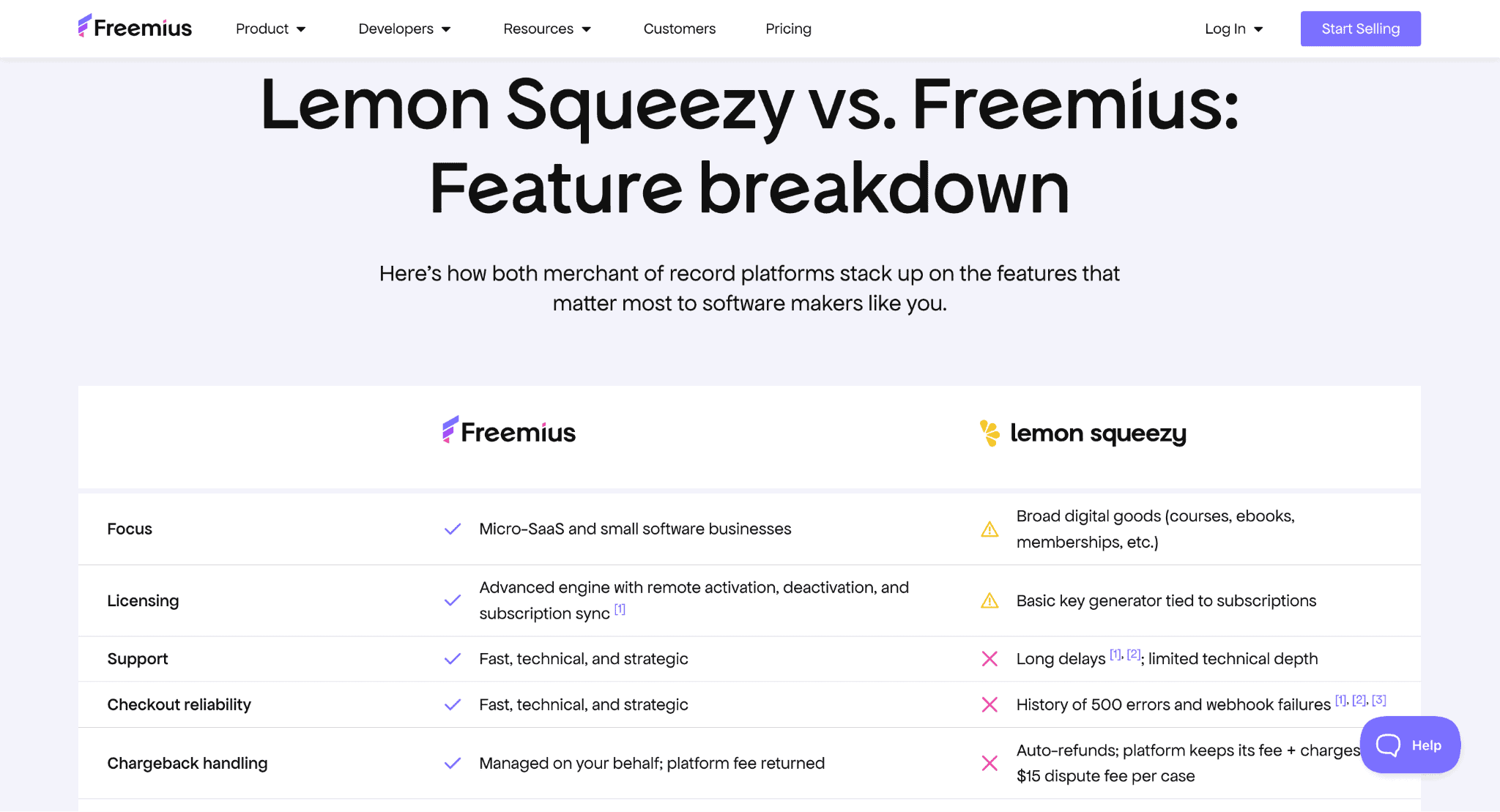
While MoR platforms restrict AI products to manage risk, Stripe removes those restrictions — but shifts the full compliance burden to you.
Stripe accepts AI products but shifts every compliance obligation to you
Stripe doesn’t restrict AI as a product category, which makes it the most permissive option for AI builders willing to manage their own compliance.
Stripe’s restricted businesses list is driven by card network rules from Visa and Mastercard, not by content-type liability. It targets categories like pseudo-pharmaceuticals, high-risk financial services, and IP-infringing content.
The platform doesn’t assess whether your product uses AI. It assesses whether your product falls into a card-network-restricted category.
AI coding tools, SaaS products, productivity apps, and AI content generators are generally accepted on Stripe.
The trade-off: using Stripe means you handle all tax compliance. Every jurisdiction where you have customers, every local VAT registration, every filing deadline — those obligations are yours.
Tools like Stripe Tax, TaxJar, and Quaderno handle this, but they require setup time, ongoing maintenance, and in most cases, budget you haven’t planned for.
Bogdan Nicholas, co-founder of VINspectorAI, an AI-powered vehicle inspection tool, moved to Stripe mid-integration after Paddle’s review stalled with no clear timeline.
That solved the approval problem but created a new one. We were suddenly personally responsible for EU VAT compliance across multiple countries. Between figuring out tax registration and finding a compliance solution, it cost us roughly three weeks and real money we hadn’t budgeted for.
The pattern repeats, and some cases are more extreme than others. Victor Karpenko, founder of SeoProfy, watched his CFO spend 15–20 hours a month just on tax filings and TaxJar.
“For a founder, the focus drain caused by tax compliance issues is a greater expense than any transaction fee,” he says.
And compliance isn’t the only operational risk that shifts to the merchant under a processor model.
Chargeback pressure is rising across digital businesses — global volumes are projected to climb 24% over the next three years, with subscription services already seeing significant year-over-year increases driven largely by “friendly fraud.”
AI products add another layer of risk, since disputes often come down to subjective judgments about output quality.
That same logic carries into how Freemius reviews AI products.
How Freemius reviews AI products: Function over labels
Freemius restricts specific AI output categories, but the evaluation is based on what your product does and who it serves — not on whether AI keywords appear in your description.
In practice, this means the review looks at function rather than labels. An AI image tool designed to generate e-commerce product mockups gets a different evaluation than one built to produce realistic human likenesses.
For a product submitted for review, Freemius evaluates:
- What the primary output is and whether it creates identity, fraud, or IP risk
- The documented use case and target customer
- Whether content moderation safeguards exist — output filtering, prohibited-use clauses in ToS, or user reporting mechanisms — for AI-generated outputs
- Data flows: what user data is sent to third-party APIs, and how the product handles sensitive credentials like API keys
John Russo, VP of Healthcare Technology Solutions at OSP Labs, went through this process after Paddle put his product in extended review.
Freemius actually installed and ran the product. They came back with specific questions about what data we were sending to third-party APIs and how we handled compromised API keys. They also reviewed our refund policy before approving. About a week end-to-end. More thorough than Paddle, but the review felt like something that was actually trying to understand the product.
Even so, Freemius does have clear boundaries. Products involving deepfakes, voice cloning, illegal impersonation, face-swap technology, or AI-generated adult/NSFW content fall outside what the platform accepts. Streaming products get evaluated carefully because of their potential connection to adult content.
What the platform handles after acceptance is the full merchant of record stack:
- Global tax collection: Calculates, collects, and remits VAT and sales tax in 100+ countries.
- Subscription billing: Manages trials, upgrades, downgrades, renewals, dunning, and failed payment recovery.
- Software licensing: Generates and validates license keys, synced automatically with subscription state.
- Checkout: Conversion-optimized, embeddable, with multi-currency and language support, coupons, and upsells.
- Customer portal: Self-serve account management embedded directly in your product.
- Affiliate platform: Built-in commission tracking, freemium conversion attribution, and coupon-based referrals.
For WordPress plugin and theme developers shipping AI-powered products, Freemius adds platform-specific infrastructure that generic MoRs don’t offer:
- WordPress licensing: Generates and validates license keys tied to site URLs, not just users.
- Update delivery: Manages plugin and theme updates directly from your Freemius dashboard.
- Freemium conversion: Tracks free-to-paid conversion inside the WordPress admin, with built-in upgrade prompts.
- In-dashboard checkout: Lets users purchase and upgrade without leaving the WordPress admin.
- SDK integration: Drop-in PHP SDK wires up licensing, analytics, and billing in hours.
Before any of that becomes relevant, your product has to pass onboarding. Here’s what to do if it doesn’t.
What to do if your AI product is rejected
If your product gets rejected mid-integration, your response depends on whether the rejection is final or conditional.
If you’re rejected before integrating: Request written clarification on the specific policy the product violates. Many rejections are addressable: a product repositioned around its workflow benefits rather than its AI output can clear review on a second submission. Document what changed between submissions.
If you’re rejected after integrating: Don’t start emergency-migrating immediately. Platforms often issue conditional rejections that request additional documentation rather than hard terminations. Confirm the status before acting.
If the rejection is final, Stripe is the fastest path to restoring payment capability — expect under 48 hours. But budget carefully for what migration actually costs.
Volodymyr Kaminovskyy, CEO of Lionwood Software, moved 500 paying customers from Lemon Squeezy to Stripe voluntarily and still came out over budget.
We lost approximately 4% of MRR within the first week of switching due to failed authentications and missed data mapping.
The tax burden was worse: moving off an MoR meant manual filing in 40+ jurisdictions, costing $15,000 in unexpected tax consulting in the first quarter alone.
The lesson: Make the platform decision before you write integration code. Once you’ve implemented billing and user flows, changing platforms requires refactoring code, migrating customer data, and handling billing and tax implications, so it directly affects revenue continuity and compliance.
Will my AI app be accepted? Five questions before you submit
Run through this checklist before submitting to any MoR or payment platform:
- Does your product generate content that could be mistaken for real people? Deepfakes and voice impersonation tools carry inherent risk regardless of platform. Expect the highest scrutiny here, and in some cases, hard rejections.
- Is AI a feature of your product, or is AI-generated content the primary deliverable? Feature-level AI is low risk across every platform reviewed here. Output-level AI (where the customer is explicitly paying for AI-generated content) gets more scrutiny at every MoR.
- Does your product have a documented, specific use case? “Audio generation tool for creating original character voices for games and animation” gets a different evaluation than “AI voice generator.” Write the specific use case into your submission, not the general capability.
- Are you selling to businesses or consumers? B2B products generally face lighter scrutiny because the end-use context is clearer. A tool sold to marketing agencies for ad creative gets a different risk profile than the same tool sold direct-to-consumer with no stated use case.
- Do you need MoR tax handling or will you manage compliance yourself? If you don’t have a tax infrastructure solution in place, the MoR model is the practical default — particularly if you expect customers in the EU, UK, or Australia. The compliance overhead of a processor model compounds quickly as you add markets.
What now? Choosing a payment platform for your AI app
The decision has two steps, and the first one is quick for most builders.
Step 1: Merchant of record or payment processor?
If you’re an indie maker or small team without a tax compliance solution already in place, use a merchant of record. Stripe is the right choice only if you have compliance infrastructure ready to deploy or if you’re building in a category every MoR will reject. For most AI builders, the MoR model is the default.
Step 2: Which MoR fits your product?
If your AI app uses AI as a feature (a writing assistant, a code tool, an analytics product, a WordPress plugin with AI built in) all three MoRs will accept you. Choose based on pricing, support level, and growth features.
If your AI app generates images, audio, or video as its primary output, the platform choice gets narrower.
- Paddle explicitly prohibits AI image generators, deepfake tools, and voice cloning — if your product falls into one of those categories, that’s a hard no.
- Lemon Squeezy doesn’t publish an AI-specific policy, so your best move is to contact their team before submitting rather than finding out mid-review.
- Freemius reviews each product on its specific use case, so the more specific your submission, the better your chances of getting approved.
The platform you start on shapes more than your first checkout — it determines your compliance exposure, your review risk, and the cost of switching if something breaks. Getting it right at the start is cheaper than fixing it later.
Not sure where your product lands? Talk to our founder and get a direct answer, instead of a weeks-long review queue.
FAQ: Payment platform restrictions for AI-built apps
Does Paddle allow AI apps?
Paddle allows AI apps where AI is a feature — code editors, writing assistants, analytics tools. It explicitly prohibits AI image generators, deepfake technology, and voice cloning tools. If your product’s primary output is AI-generated visual, audio, or video content, it falls outside what Paddle accepts.
Will Lemon Squeezy reject my AI product?
Not necessarily, but expect manual review. Lemon Squeezy flags AI keywords in your product description and landing page, which adds 2–5 business days to your launch timeline — sometimes longer. Outright rejections are less common than documentation requests, so have your use case, data handling details, and content policy ready before you submit.
Is Stripe safe for AI apps?
Stripe doesn’t restrict AI as a category — coding tools, SaaS products, and content generators are all accepted. What Stripe does restrict are card-network-prohibited categories like financial fraud and IP violations, which most AI products don’t touch. The real risk with Stripe is that every tax filing, VAT registration, and compliance obligation across every market you sell in falls on you.
What’s the difference between an MoR and a payment processor for AI apps?
A merchant of record is the legal seller of your product — they carry the tax and compliance liability, which is why their acceptable use policies are stricter. A payment processor routes the transaction but you remain the legal seller, so the liability stays with you. Fewer product restrictions, but every tax filing, VAT registration, and compliance obligation across every market you sell in is your problem to solve.
Can I sell AI-generated images through a payment platform?
Yes, but the platform determines whether it’s straightforward or not. Paddle prohibits AI image generators outright. Stripe allows them as long as the content doesn’t violate IP or card network rules. Freemius accepts them case by case — a mockup tool for designers gets a different answer than a tool that generates realistic human likenesses. Document your specific use case before submitting to any platform.
What should I include in my product description when applying for an MoR review?
Lead with what your customers use it for, not what technology it runs on. Include the target customer type, any content moderation or output safeguards your product applies, and explicit clarification that it doesn’t involve deepfakes, voice impersonation, or NSFW content (if it doesn’t). ‘Conversion mockup generator for Shopify sellers’ gets a faster, cleaner review than ‘AI-powered image platform’ — same product, very different first impression.
Does Stripe require me to collect sales tax for AI apps?
Yes, Stripe doesn’t collect or remit sales tax or VAT on your behalf. You’re the legal seller, so every jurisdiction where you have customers is your responsibility. EU VAT, UK VAT, US sales tax nexus rules, Australian GST — all yours. For AI apps with a global user base, that compliance footprint adds up fast.