|
|
Getting your SaaS go-to-market strategy right without a budget doesn’t mean doing everything on a smaller scale. It means doing one thing well. The three motions that work for early-stage SaaS founders are:
- Product-led
- Community-led
- Content-led
Most other approaches assume more resources than a bootstrapped founder has.
Among the founders we spoke with, those who spread across multiple channels early consistently lost three to six months before committing to one. During that time, none of the channels had enough sustained input to compound.
Their experiences reveal what drives traction, what kills momentum, and how to choose the right motion for your product.
TL;DR: Which SaaS Go-to-Market Strategy Should You Choose?A SaaS go-to-market strategy is simply how you get your first paying customers. For bootstrapped founders, this means picking one channel and committing to it long enough for it to work.
|
Two Questions That Decide Your SaaS Go-to-Market Strategy
1. Can a user get value from your product in <10 minutes, without your help?
For Pavankumar Kamat, co-founder and CEO of Panto AI, the answer was yes. Developers could build and validate a small automation in 10 minutes and see a result immediately, so product-led was the obvious fit.
If your answer is no and the value only becomes clear after a demo or an explanation, you need to educate your buyers before you can convert them. That points to community-led or content-led first.
2. Does your target audience actively search for solutions, or do they participate in relevant communities?
Nikhil Pai, founder of Chronicle, knew his buyers googled for specific workflow questions like “how to track ALJ hearing deadlines” or “how to manage disability claim deadlines.” They weren’t browsing communities looking for tools, so content-led was the only motion that put him in front of the right people.
Nicky Zhu at Dymesty had the opposite situation. Her buyers were concentrated in small, specific Discord servers and Slack groups. Community-led was the only path that generated a paying customer within 30 days.
To find your starting point, use the decision tree below.
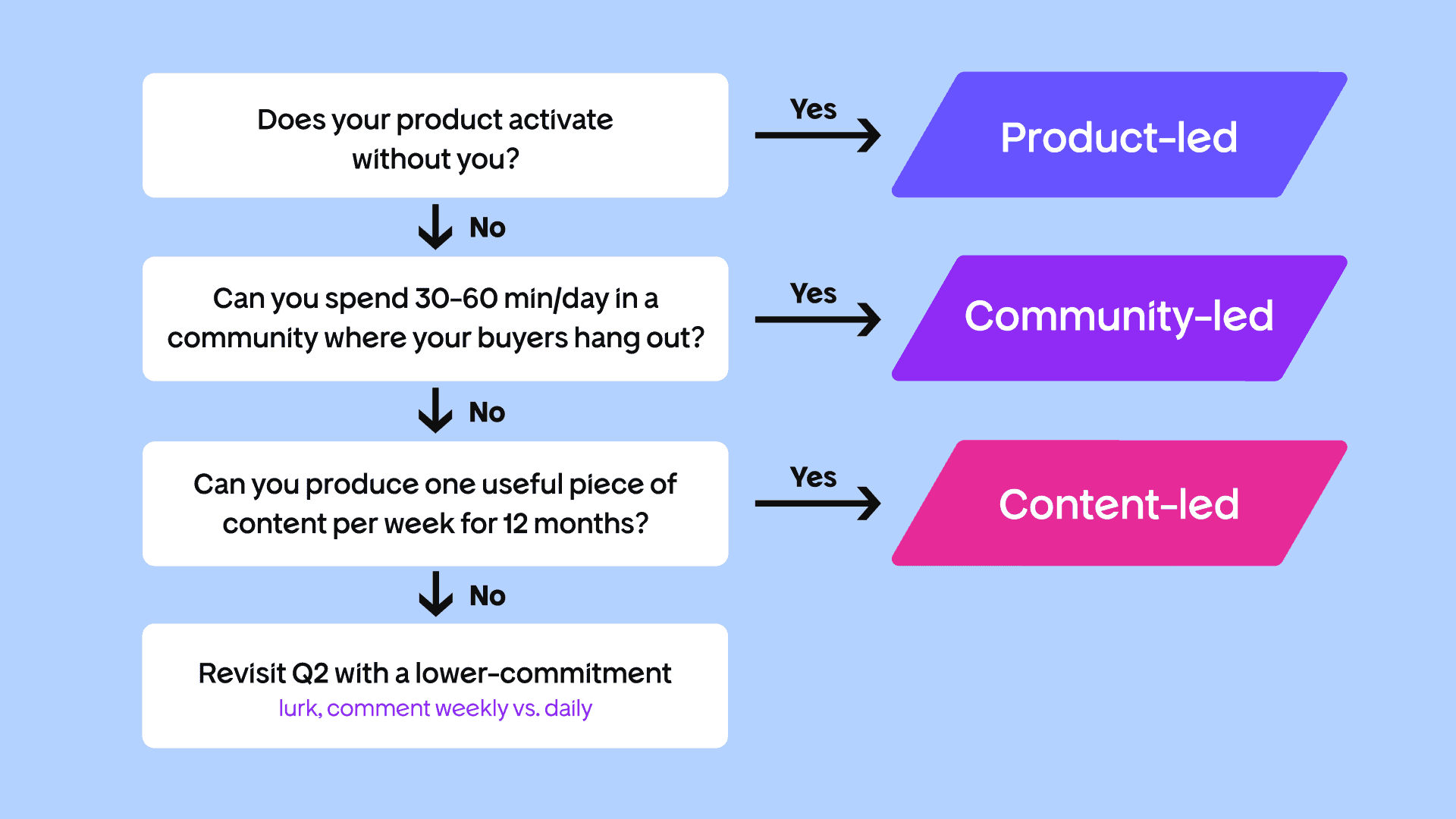
If you’ve worked through all three questions and none of them produced a clear answer, your product might need a more direct approach. Our breakdowns of outbound sales tools and SaaS sales strategy cover what that looks like for small teams without a dedicated sales function.
Found your strategy? Let’s see how to make it work.
Product-Led: Make the Product the Pitch
Product-led growth means the product does the selling: a user signs up, experiences value, and either pays or refers to someone who does.
But this loop requires activation. If your free trial requires a CSV import, settings walkthrough, and 20 minutes of configuration before anything works, users will churn.
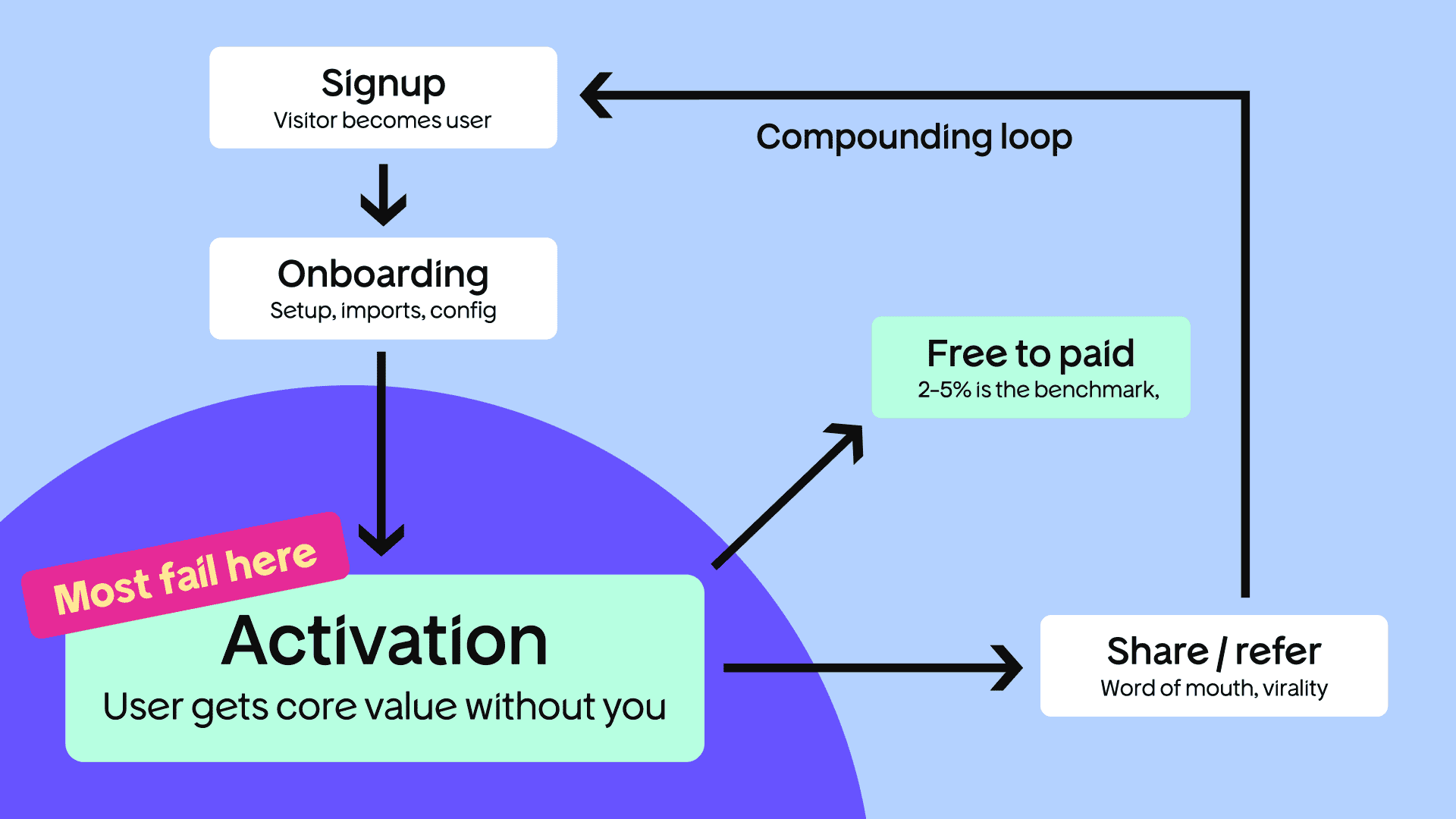
While most founders focus on acquisition before activation, Dimi Baitnciuc, CEO and co-founder of Brizy, tracked weekly active users who built and published a page.
“When we saw that number steadily increasing, it meant users weren’t just signing up, they were actually using the product. Shortening the time between signup and building the first page turned out to be one of our strongest growth levers.”
How to Execute PLG With No Budget
Start from the result you want users to reach, then work backwards and remove every step that isn’t directly getting them there.
Marin Cristian-Ovidiu, CEO of OnlineGames.IO, watched his activation rate sit at 20% because players had to work too hard before moving to the fun part.
“After rebuilding our onboarding to be simpler and more direct, activation moved to 45% and free-to-paid conversion rose from 1%–2% to 4%–5%.”
Dario Ferrai, co-founder of All-in-One-AI, was one of those who invested in acquisition before fixing activation.
“I spent six weeks building a LinkedIn audience while activation sat below 20%. Users would sign up, click around for three minutes, and then disappear.”
When he stopped acquisition work and rebuilt onboarding, activation crossed 50% in eight weeks.
The lesson: no amount of acquisition fixes a broken path to value.
Here’s how to fix it.
Simplify Signup
The fewer decisions a user makes before seeing value, the more likely they are to stick around.
Example: instead of asking users to set up a profile, choose a plan, and configure settings, show them one useful thing and save everything else for later.
Pre-Fill Content and Defaults
Show users what the product looks like when it’s working, before they’ve set up anything.
Example: a project management tool that opens with a sample project, pre-populated tasks, and a demo board, rather than an empty screen asking “create your first project.”
Show a Result Before Asking for Anything
Don’t ask users to pay before they’ve seen what they’re paying for. Show the value first, then present the upgrade. And when you do present it, make sure your pricing page is doing its job.
Example: an SEO tool that runs a free site audit on signup, before asking for payment or account details, gives users a result to act on.
Find Your Viral Loop
Look for the moment where one user’s action puts your product in front of someone who hasn’t signed up yet.
Example: a website builder where every published site carries a “made with” badge.
Once these things are in place, satisfied users talk, share, and refer without being asked.
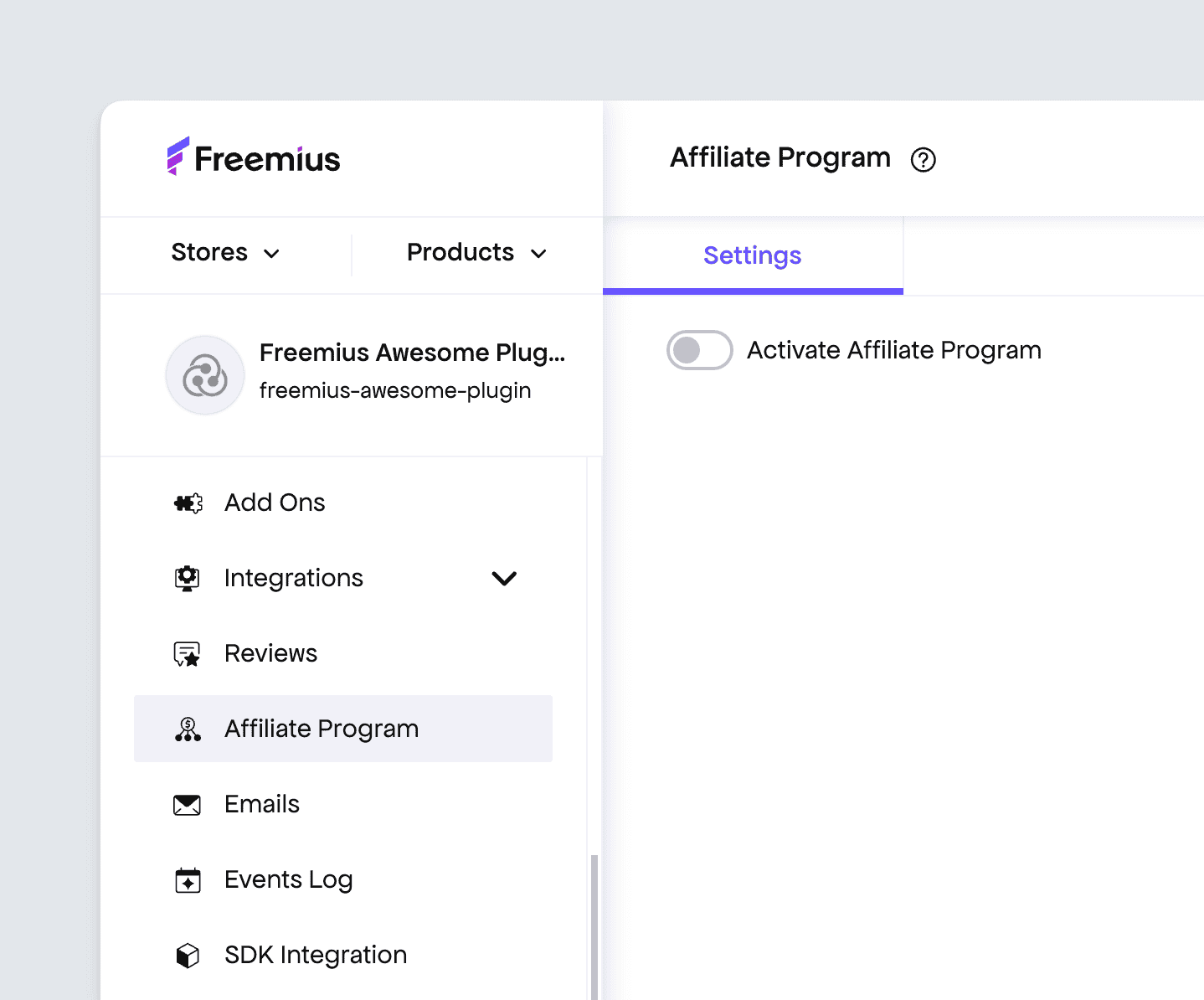
To fuel that fire, Freemius’ built-in affiliate platform lets you set up an affiliate program and define commission rates to reward users who bring others in.
How to Know If It’s Working
For all Dimi, Marin, and Dario, the first confirmation was users returning and using more of the product.
Here’s how to track whether the same is happening for you:
- Activation rate: % of signups who reach the core value moment
- Time-to-activation: how long after signup that moment happens
- Free-to-paid conversion rate: for broad-market SaaS tools, 2%–5% is a typical early-stage range.
Pro tip: Ask every new user how they heard about you. Connecting acquisition source to activation rate tells you which channels bring users who actually stick.
If your product requires buyers to discover it through trust rather than trial, community-led is where you build that trust.
Community-Led: Show Up Where Your Buyers Already Are
Community-led growth means acquiring your first customers from communities where they spend time.
But that only works if you contribute before you promote.
The mechanism is straightforward: answer questions, share resources, and help people solve problems. Over time, the community associates you with expertise. When you mention your product, it lands as an honest recommendation from someone they already trust.
Nicolas More, founder of Reddinbox, spent the first three months in r/SaaS, r/startups, and r/Entrepreneur with no pitches or links.
“Month four was when I finally shared how I validated Reddinbox using Reddit data. The post took off with 1,200+ upvotes and brought in my first real inbound wave. The post still drives signups today.”
Many founders get this backwards. They join a community, post a product link on day one, and wonder why nobody clicks. Communities reward members who give first. Founders who show up only to promote get ignored, flagged, or banned. Either way, nobody buys.
Whether you build trust or burn it comes down to how you show up:
| This builds trust | This gets you ignored or banned |
| Answering questions with no product mention | Opening your first post with a product link |
| Sharing a resource that helps, even if it’s not yours | Posting “Check out my SaaS” with no context |
| Giving feedback on someone else’s work | Dropping your link in every relevant thread |
| Doing 10 genuine replies before one mention | Promoting before you’ve contributed |
How to Build a Community Presence That Converts (Without a Team)
Building a community presence that converts comes down to one principle: give before you ask.
It requires 30 to 60 minutes of genuine participation per day. That’s why it pays to be selective about where you spend it.
Nicky Zhu from Dymesty, learned this firsthand. Their initial attempts to find customers targeted subreddits like r/Wearables and r/Productivity, both of which are large but yielded almost no conversions.
“The first 50 customers came from three Discord servers focused on Quantified Self and two Slack groups for hardware founders. These were people already paying to solve the exact problem we address.”
The lesson: The right community matters as much as the right approach.
Here’s how to get both right.
Pick One Community and Go Deep Before Expanding
Popular general communities produce low conversion because your ideal buyer is a small percentage of the audience. Smaller, more specific ones are worth far more.
Good starting points: r/SaaS, r/micro-SaaS, r/side-project, Indie Hackers, MicroConf Connect, Freemius Community, and niche vertical Slack/Discord groups.
Contribute Genuine Value First
Answer questions, share frameworks, give feedback on others’ work. Do this for weeks before mentioning what you’re building.
Example: If you’re building a project management tool for agencies, spend the first month answering workflow questions in an agency-focused Slack group before you mention your product.
Mention Your Product Only When It’s The Natural Answer
Not as a promotion, but as a response to a specific problem someone is already asking about.
Example: “I actually built something for this exact problem, happy to share if it helps,” lands very differently than “Check out my SaaS.”
Consider Building In Public
Sharing milestone posts on Indie Hackers or X creates an audience before you have a product to sell. You’re contributing to a community’s culture while building an asset that compounds over time.
Example: Weekly build updates on Indie Hackers that document decisions and numbers attract an audience that’s invested in your outcome before you ever ask them to try the product.
How to Know If It’s Working
The early signals from community-led growth live in unsolicited DMs, unprompted mentions, and strangers recommending your product in threads you never posted in.
Here’s how to measure them:
- Referral traffic from community profiles and posts: use UTM (trackable URLs) links on any URL you share
- Direct signups attributed to community: ask in onboarding “How did you find us?”
- DMs and profile visits generated in the 48 hours after participating in a thread
Pro tip: If by month three, there are no DMs, profile visits, or traceable signups, step back and ask: is my buyer actually in this community, and have I been genuinely helping or just waiting for a chance to pitch?
If community-led puts you in the room with your buyers. Content-led brings them to you.
Content-Led: Build the Audience Before You Need Them
Content-led growth means your buyers come to you. You publish content that answers the questions they’re already asking, and your product is the answer they land on.
- Search-traffic content targets specific queries your buyers type into Google. It’s slow to build, but once it ranks, it mostly runs without you.
- Audience-building content (newsletters, build-in-public posts on X or Indie Hackers, YouTube) has a faster feedback loop but requires consistent output over time.
The catch is time.
- Joosep Seitam, co-founder of Socialplug, saw almost nothing from organic content in the first three months.
- Jacob Kalvo, co-founder and CEO of Live Proxies, didn’t see meaningful trial traffic until month four.
- Andrew Swiler, founder of Answer Maniac, waited nine months.
All three are still benefiting from content they published when nothing seemed to be working. Getting there starts with picking the right format.
How to Choose Your Format
Format choice comes down to two things:
- Where your buyers look for solutions and
- What you can keep producing for 12 months
Get one wrong and the other doesn’t matter.
| If you… | Use this format |
| Write well and think in systems | Blog (SEO or purely educational) |
| Are comfortable on camera | YouTube |
| Work well with short-form, daily rhythm | X / Indie Hackers build-in-public |
| Have a distinct POV and a small existing audience | Newsletter |
Andrew chose long-form educational content from day one.
“Our product directly addresses a new AI visibility problem for businesses. The issue is so new that our target audience doesn’t even know they have it yet.
So, my job is education first and selling second. I wrote around questions people were already asking, like how AI tools surface brand recommendations, and used those articles to introduce the problem my product solves.”
Jacob went all-in on SEO first because his buyers were already searching for solutions, tutorials, and comparisons before purchasing.
“If I could do it again, I’d still prioritize SEO early, but I would start building an owned audience (like an email list or newsletter) sooner instead of relying almost entirely on search traffic.”
Pro tip: Add an email capture to every piece of content you publish from day one. Search traffic is valuable, but an email address is an asset you own regardless of what Google does next and the right marketing automation setup is what turns that list into revenue.
How to Execute Content-Led With No Budget
Write for the stage your buyer is at. Some buyers are actively searching for a solution. Others don’t know the problem exists yet. Either way, the content has to meet them where they are.
Joosep from Socialplug, spent his first two months targeting keywords with strong search volume but weak purchase intent. A term like “social media marketing tips” drove significant traffic but nearly zero conversions.
“The content that worked was the one targeting the intent of someone who already knew they had a problem and were actively looking for a solution. A keyword like ‘buy aged Instagram accounts’ had a fraction of the search volume but converted at over 15%.”
After shifting to intent-matched content:
- Organic traffic drove 60%–70% of all new trial signups by month eight
- 8% of published content (articles targeting specific problems) drove 40% of trial signups
Here’s how to get there.
Target Intent, Not Volume
Start with keywords that signal where your buyer is in their thinking, not just how many people search for a term.
Example: “best project management tools for agencies” converts better than “what is project management” even if the latter gets ten times the search volume.
Go Narrow and Specific
Broad content competes; specific content owns a niche. Address one problem for one type of buyer precisely, and the conversion rate rises.
Example: “time tracking software for freelance developers” is more specific than “best time tracking software” and will convert better, even with a fraction of the search volume.
Write Long-Form
Short posts answer surface questions. Long-form content solves real problems and builds trust that leads to a demo booking or a trial signup.
Example: a single in-depth guide on how to reduce SaaS failed payments will convert better than five shorter posts on billing and churn.
Publish Consistently
One genuinely useful post per week beats three shallow ones. Commit to a cadence you can sustain for six months, not one you’ll abandon after three weeks.
Example: publishing every Tuesday for six months builds more domain authority and reader trust than publishing daily for three weeks and then going quiet.
How to Know If It’s Working
The first signs that content-led is working are quiet: a keyword starts ranking, impressions climb, someone books a demo and mentions a specific post.
Here’s how to track those signals before they show up in revenue:
- Google Search Console impressions and clicks: growing month over month is the earliest positive signal
- Trial and signup rate from organic traffic: not overall traffic, but the subset coming from search
- Newsletter open rate and subscriber growth: if you’re building an owned audience alongside SEO
- Content-attributed MRR: ask in onboarding where a user found you, then connect that back to specific content
Once you have both signup data and content traffic data, connect them. Which content is producing users who actually activate, not just users who visit? Those are the topics worth doubling down on.
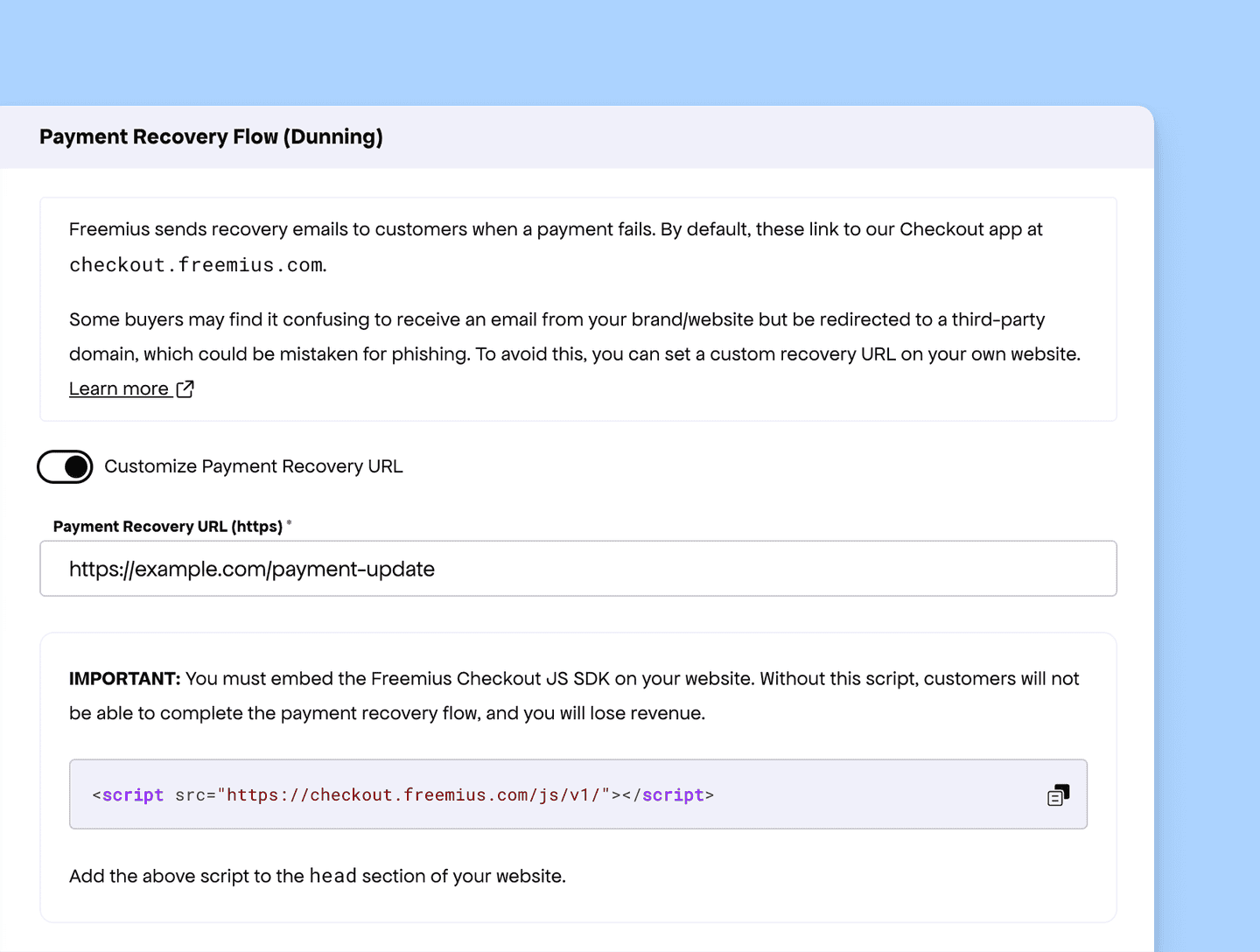
The users who visited, signed up, and didn’t activate are worth following up on too. Freemius automatically handles marketing automation, recovering abandoned checkouts and recovering failed payments.
Pro tip: If nothing is ranking after six months, stop publishing and audit your keywords. You’re either targeting terms that are too competitive for a new domain or writing about topics your buyers aren’t searching for. Find lower-competition, higher-intent terms and rebuild from there.
The Operational Drag Most Founders Don’t Anticipate
Every founder in this article mentioned the same unexpected constraint: billing, payments, tax compliance, and basic support eating into the time they’d set aside for growth.
Every hour you spend fixing failed payments or dealing with VAT is an hour you’re not spending on improving onboarding, showing up in communities, or writing content. When you’re just starting out and time is all you’ve got, that trade-off costs a lot.
The founders we spoke with spent anywhere from 8 to 15 hours per week on operational tasks in the early months. None of it helped them acquire a single customer.
And that’s before accounting for the complexity of selling globally that involves currency conversion, local payment method preferences, regional fraud patterns, and tax registration requirements that vary by country.
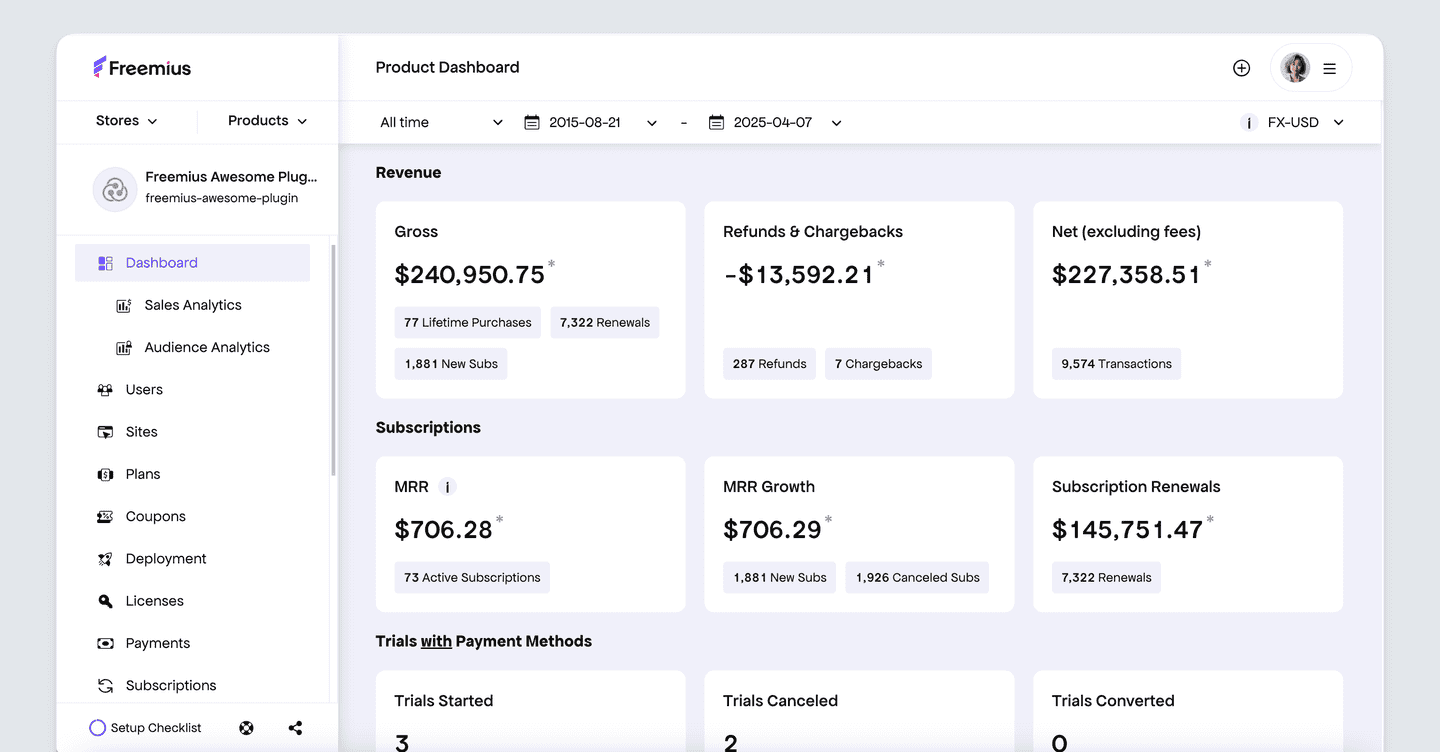
Freemius removes the overhead. As a Merchant of Record, it handles the legal and financial responsibilities:
- Retry logic: Automatic failed payment recovery
- Subscription management: Platform-level upgrade, downgrade, and cancellation flows
- Tax compliance: Automatic VAT, GST, and US sales tax coverage
- Cart abandonment recovery: Revenue recovery without intervention
- License and feature management: Platform-level access controls
The time those systems would otherwise consume goes back to the one GTM motion you picked.
Whichever motion you choose, none of it compounds if operational overhead is eating the time you’d spend executing it.
Pick One SaaS Go-to-Market Strategy and Run It
Bootstrapped founders often switch playbooks too early.
- Content-led growth is slow.
- Community-led requires contribution.
- Product-led needs activation.
All three look like they’re failing before they start working. If you switch too early, you’ll never find out which one would have worked.
Whichever playbook you commit to, make sure operational overhead doesn’t derail it. If you’re ready to stop losing 8–15 hours a week to payments, compliance, and billing infrastructure, explore how Freemius handles that for you.
When to Keep Going or Pivot Your SaaS Go-to-Market Strategy
Give each playbook time.
| Playbook | Minimum window | Keep going if… | Reconsider if… |
| Product-led | 60 days after fixing onboarding | Free-to-paid conversion above 2% and activation climbing | Activation at ~30% and not improving after two onboarding iterations. Users aren’t returning. |
| Community-led | 90 days of consistent participation | DMs coming in, referral traffic growing, profile visits after threads | No DMs, profile visits, or traceable signups after 90 days. |
| Content-led | 6 months of consistent publishing | Search Console impressions climbing and organic traffic generating signups | Nothing ranking after six months. |
FAQ
What is a SaaS go-to-market strategy?
A SaaS go-to-market strategy is how you acquire your first paying customers. Pick one channel (product-led, community-led, or content-led) and execute it until the data tells you whether it’s working.
How do I market a SaaS product with no budget?
Pick one of three channels — product-led, community-led, or content-led — and run it for at least 60 to 90 days before evaluating. Offload payments, billing, and tax compliance to Freemius (merchant of record) so that time goes toward growth instead.
What is product-led growth for a bootstrapped SaaS?
Product-led growth means the product is your primary acquisition and conversion tool. Users sign up, experience the core value without your involvement, and convert to paid. It only works if onboarding gets them to the “aha moment” quickly. If activation requires a demo or explanation, a different GTM motion comes first.
How long does SaaS content marketing take to work?
Six to twelve months before organic content generates consistent trial traffic. Months one through three produce little measurable return. Months four and five begin to show compounding if keywords and intent are right. Month six onward is when content starts driving meaningful signups, assuming consistent output from the start.
What’s the difference between community-led and content-led SaaS marketing?
Community-led means building trust through genuine contribution in the spaces where your buyers already spend time (Reddit, Slack groups, Discord, Indie Hackers) before mentioning your product. Content-led means ranking for the queries your buyers type when they have a problem. Community-led produces faster early results (faster than content-led in the early stages, though still requiring sustained efforts). Content-led builds a more durable asset over time. Both require consistent effort before they compound.