|
|
Lovable Payments is Lovable’s built-in monetization feature. It lets you add subscriptions and one-time payments to any Lovable app using Stripe or Paddle without setting up a separate payment account or writing any code.
If you’ve just shipped your first Lovable app and someone wants to pay you, Lovable Payments is probably the right next step.
But there’s a version of this story where you’re six months in, you want to run a pricing experiment, your AI product got flagged by Paddle, and you realise the checkout setup you chose on day one is now limiting your business.
This guide is about understanding which version of that story you’re in before you choose.
What is Lovable Payments?
Lovable Payments is a native monetization layer for AI apps created in Lovable. It allows builders to accept subscriptions and one-time payments without setting up a custom payments backend.
What Lovable Payments supports:
- SaaS apps with subscription tiers
- Consumer apps with premium unlocks or one-time purchases
- Memberships and communities with recurring access fees
- Digital downloads such as e-books, templates, courses, or music
- Developer tools with API access or usage-based plans
What you need:
- Pro plan or higher
- Lovable Cloud enabled: a hard requirement, not a default setting
- Authentication set up in your app — recommended so purchases can be linked to individual users
What Lovable Payments handles:
- Payment provider account creation (onboarding and verification still required)
- Webhook registration and handling
- Isolated test and live environments
- Revenue analytics via the Payments tab: net revenue and active subscription charts (7, 30, and 90-day ranges) and a full transaction log
- An Adjustments section covering refunds, credits, and chargebacks
How Lovable Payments works — from setup to going live
1. Prompt Lovable to add payments
Tell Lovable you want to accept payments — for example, “Add a pricing page to my app with a $29/month subscription” — and it analyses your project and recommends either Stripe or Paddle based on what you’re selling and where.

2. Create your products and prices
Still inside the builder, you define your products and pricing via prompt — for example: “Create three pricing tiers: Starter at $9/month, Pro at $29/month, and Business at $99/month” or “Create a one-time payment of $49 for lifetime access.”
Lovable Payments handles the rest: it creates the checkout flow, builds the UI components in your app, and manages the underlying billing system — including subscriptions, trials, and discount codes. You can prompt those directly too: “Add a 14-day free trial to the Pro plan” or “Create a 20% discount code LAUNCH valid for the first 3 months.”
3. Test before anything goes live
You can test everything in your project preview using the test card numbers Lovable provides, from successful payments to failed transactions and subscription renewals.
4. Go live after verification
This is where the timeline gets less predictable with Lovable Payments. Going live requires completing your provider’s verification process first.
- Paddle: KYC/KYB form, domain review, and a readiness check confirming your live site has a privacy policy, terms of service, and refund policy in place. Approval timelines vary. In practice, Paddle can take anywhere from a few days to several weeks, particularly for AI-adjacent products.
- Stripe: Onboarding happens partly outside Lovable, directly in the Stripe dashboard. You claim the account Lovable created, complete identity verification, and install the Lovable app on your live account. Note: the email address you use to register your Stripe account cannot be changed after setup.
| Before you submit for verification: Use a custom domain rather than your default .lovable.app address. Providers review your live domain as part of verification, and a custom domain reads as more credible — this one step can meaningfully reduce the risk of delays or rejection. |
Your Payments tab includes a go-live checklist that tracks each required step. Use it to confirm everything is in place before submitting for verification. Until verified, your app cannot process payments and going live takes as long as your provider decides it takes.
Stripe vs Paddle: How to choose the right payment provider for Lovable Payments
Lovable Payments supports two built-in providers: Stripe and Paddle. Stripe is a payment processor — you own tax and compliance. Paddle is a merchant of record — it handles tax and compliance for you. Which one Lovable recommends depends on what you’re selling and where.
Here’s how they compare:
| Paddle | Stripe | |
| Model | Dedicated Merchant of Record on every transaction | Payment processor (not a default MoR) |
| Best for | Digital products and software only | Digital products, software, and services |
| Pricing | ~5% + 50¢ per transaction (varies by plan and volume) | Standard pay-as-you-go — see Stripe pricing breakdown for SaaS |
| Tax handling | Fully automatic — global tax collection, invoicing, and receipts included | Not included by default — Stripe Tax is an add-on; MOR tax handling via Managed Payments is available in limited countries only |
| Checkout style | Overlay popup or embedded inline on page | Hosted checkout or embedded components |
| AI product scrutiny | Higher — additional checks required | Standard |
| MoR country coverage | Global coverage for digital products | Depends on your setup; you manage tax and compliance if Managed Payments isn’t available in your country |
Choose Paddle if:
- You’re selling globally and want tax compliance handled automatically
- You have a straightforward digital product or SaaS
- You want predictable, flat-rate pricing with most costs bundled into a single fee
Choose Stripe if:
- You want more flexibility and control over your billing and pricing structure
- You’re comfortable handling tax, compliance, and billing setup yourself by default
For Stripe, it’s worth understanding what “pay-as-you-go” pricing actually means. The advertised 2.9% + 30¢ is the floor, not the ceiling.
Once you factor in Stripe Billing for subscriptions (+0.7%), international card fees (+1.5%), and currency conversion, Stripe’s real cost for SaaS businesses can add up fast.
For example: a $100 subscription renewal from an international customer could incur 2.9% + 30¢ base, 0.7% for Stripe Billing, and 1.5% for the international card fee. This totals around $5.40, or roughly 5.4% of the transaction, before any currency conversion costs.
Can you use Lovable Payments for all Lovable apps?
In many cases, yes — but only within the limits set by the payment providers it relies on.
The Paddle problem
Paddle’s Acceptable Use Policy explicitly restricts AI-generated images, face swaps, deepfakes, and voice impersonations. Beyond those hard limits, Paddle has added broader scrutiny to generative AI products. In their own words:
“In recent years we put more rules in place around generative AI products and services… we need to complete the right checks in order to reduce the risk to customers — we might request additional information from you during this process.”
The consequences show up in maker communities. One builder on r/SaaS described finishing their MVP — an AI-powered photo generator — applying to Paddle, and getting rejected with no clear explanation. As one commenter put it:
“Paddle recently announced they would not accept applications from ‘generative image AI companies.’ It’s due to the risk of generating prohibited content.”
What makes this particularly frustrating is the lack of clarity in these cases. When the builder emailed Paddle for clarification, the response was the same: they reserve the right not to explain why a product is accepted or rejected.
As another commenter noted: “AI-based SaaS sometimes triggers risk flags on platforms like Lemon Squeezy and Paddle, even if your product doesn’t technically fall under their prohibited categories.”
It’s also worth knowing that Paddle settled a $5 million FTC case related to facilitating deceptive payment practices. This is a reminder that account closure risk on this platform isn’t just a community anecdote. It’s documented at a regulatory level.
What about Stripe?
Stripe tends to be more flexible for AI-built products. Their restricted businesses list doesn’t specifically target AI tools, making it the lower-friction path for most vibe coders building in this space.
That said, approval still depends on what you’re selling and how it’s described. And without full merchant of record coverage, tax and compliance responsibility sits with you, which is less abstract than it sounds.
In practice it means tracking economic nexus thresholds across US states, registering for VAT once you cross country-specific revenue thresholds in the EU, generating compliant invoices for B2B customers in different jurisdictions, and handling currency-specific tax rules yourself.
These obligations vary by country, kick in at different revenue levels, and can apply retroactively if you’ve been selling into a market without realising you had a filing requirement.
What Lovable Payments does well
For a straightforward SaaS or digital product, the speed advantage is real.
“Lovable just made the most painful part of building apps completely disappear. You describe what you want to sell. Lovable builds the entire payment flow: Stripe integration, Checkout UI, Database tables, Subscription logic…” — @PrajwalTomar_ on X
Speed and simplicity
- No upfront account setup — Lovable creates and connects your provider account for you
- Checkout flow, pricing page, and UI built via prompt
- Test environment active immediately after setup
- Products and prices sync automatically between test and live environments on publish
Infrastructure handled for you
- Webhook registration and management
- Isolated test and live environments
- Backend logic for subscriptions and access is handled automatically
- Customer portal connected via a single prompt
- Basic subscription lifecycle handling (billing, renewals, and cancellations)
- Global tax collection, invoicing, and receipts handled automatically when using Paddle
What are the limitations of Lovable Payments?
Lovable Payments starts to feel restrictive once your product needs things like multiple subscriptions per user, feature-level access control, evolving pricing tiers, or full checkout customisation.
Technical lock-in
The most consequential limitation for vibe coders and AI builders is that you can only use one payment provider per project. If you start with Paddle and later need Stripe — or vice versa — the switch is neither quick nor clean.
The same logic applies if you’re using Stripe via a Connector inside Lovable. There’s no seamless path to switching over to built-in payments, and you’d need to remove the existing integration and set it up again.
Two more conditions worth knowing upfront:
- The project can’t be remixed or forked once payments are enabled. If you want to duplicate it to test a new pricing model, build a variant, or hand it off, the option is gone.
- Built-in payments require Lovable Cloud. If you’ve already built on an external Supabase instance for greater database control, you’d need to rebuild on Lovable Cloud or find a different monetization path entirely.
There’s also a subtler risk that compounds over time: the pricing model you ship with is almost never the one that works. Most founders reprice within the first six months by restructuring tiers, adding usage components, or testing annual billing.
With Lovable Payments, any structural pricing change means working around infrastructure you didn’t fully control from the start. The friction is manageable at first, but it grows.
Monetization limits
One subscription per user per environment by default: Each user can have one active subscription. If you need add-ons or multiple subscriptions, ask Lovable to adjust this.
Failed payment recovery isn’t handled: When a card declines on renewal, Lovable Payments doesn’t automatically retry the charge or prompt the customer to update their details.
For a product with 200 active subscribers, even a 5% involuntary churn rate from failed renewals means losing 10 subscriptions per cycle, with no cancellations, just cards that declined in the background. At scale, this becomes one of the most expensive silent leaks in a subscription business.
Discounts don’t sync: Any discount codes you set up during testing have to be manually recreated in your live environment.
Checkout is configured outside Lovable: Your checkout appearance, fonts, colours, and payment methods are all configured in your provider’s dashboard. If branding matters — and for a paid product, it should — your checkout is often the first real touchpoint customers have with your brand. Yet every change requires going through a separate workflow.
Customer portal can’t be previewed: You can’t fully preview the subscription management experience inside Lovable. You’ll need to deploy and test it on your live site.
None of these are dealbreakers for a simple SaaS or digital product. But the more complex your pricing becomes, the more you end up working around the default setup. Some builders — especially once they move beyond a simple subscription — find that neither Stripe nor Paddle fully covers what they need. In those cases, they add a separate monetization layer instead.
Need dunning, feature-level paywalls, or the ability to switch providers?
Freemius handles failed payment recovery, feature gating, multiple subscriptions per user, and global tax compliance, and integrates with Lovable via a single prompt. See how it works →
We also cover this in our guide to the best payment solutions for AI-built apps, where built-in payments are often only the starting point.
When to use Lovable Payments and when to look for alternatives
| Use Lovable Payments if… | Consider an alternative if… |
| You’re launching a new project with a simple subscription or one-time payment model | Your project runs on external Supabase |
| Your product is straightforward, with no complex access logic | You’re building an AI product and want to avoid potential provider approval friction |
| You want to get to a working checkout quickly without managing a separate platform | You need more than one active subscription per user |
| You need advanced licensing or feature gating | |
| You want full control over checkout branding and pricing experience | |
| You expect your pricing model to evolve |
When an external monetization layer makes more sense
A dedicated monetization platform — one that sits on top of your payment processor rather than replacing it — gives you control over pricing, subscriptions, access, and compliance independently of the underlying provider.
A simple test:
Does your product fit cleanly into a single subscription or one-time payment, with no complex access logic underneath?
If yes, Lovable Payments will likely serve you well.
If you’re hesitating — for example, if you’re planning add-ons, experimenting with pricing, expecting different user tiers, or building an AI product that may trigger provider checks — that hesitation is usually a signal.
When you need more than Lovable Payments offers
Lovable Payments works well for a simple subscription or one-time payment. Once you need feature gating, multiple subscriptions per user, failed payment recovery, or provider flexibility, you need a dedicated monetization layer.
One way builders address this is by introducing a dedicated monetization platform that sits alongside their Lovable app, rather than replacing anything.
The most common alternatives to Lovable Payments are:
- Stripe or Paddle direct — more manual configuration, but full control over billing logic and pricing structure
- Lemon Squeezy — a merchant of record platform for digital products, simpler than Stripe with less scrutiny than Paddle
- Gumroad — straightforward for simple digital products and one-time purchases
- Shopify — If you’re selling physical products, Lovable also has a separate Shopify integration that handles e-commerce, inventory, and fulfilment.
- Freemius — a full monetization layer built for software makers; handles subscriptions, feature gating, affiliate management, and global tax compliance, and integrates with Lovable via a single prompt
Freemius is a merchant of record and was built specifically for software makers and their unique needs from day one.
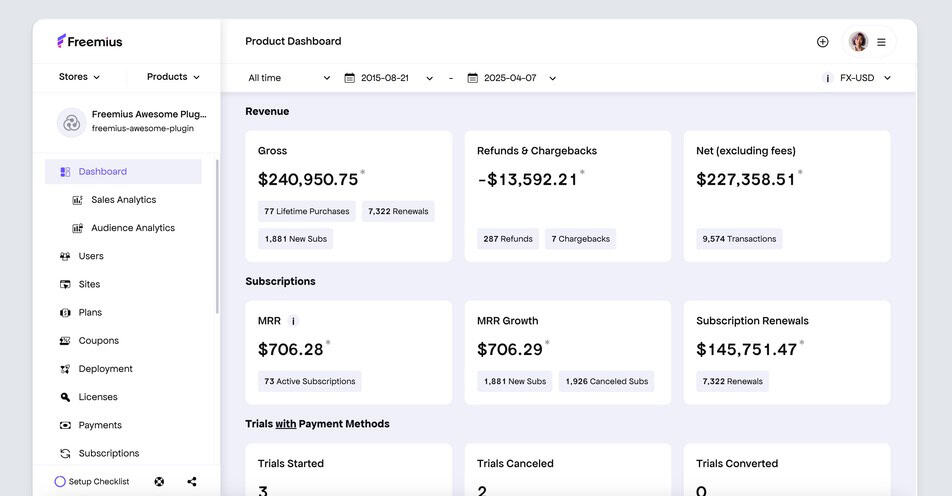
For AI builders specifically, Freemius doesn’t impose category-level restrictions on AI-built software, and AI-powered services are explicitly listed as an acceptable product type. This isn’t a loose policy: Freemius still prohibits illegal products, adult content, hacking tools, and anything deceptive or high-risk.
The difference from Paddle is structural. Paddle screens sellers against prohibited category lists before approving accounts, which means generative AI products often trigger flags regardless of what they actually do.
Freemius reviews whether a product is legitimate software built by its creator, not what AI category it falls into. For a vibe coder building a productivity tool, an AI assistant, or a SaaS app, that distinction is the difference between a smooth onboarding and a rejection with no explanation.
| Lovable Payments | Freemius | |
| Subscriptions and one-time payments | Supported — via Paddle or Stripe | Supported — configured from your Freemius dashboard |
| Feature gating and paywalls | Not supported natively | Built in |
| Checkout control | Limited (configured in Stripe/Paddle dashboards) | Full control (branding, upsells, coupons, payment methods) |
| Affiliate management | Not supported | Built in |
| Customer portal | Basic / provider-dependent | Built in (self-service subscription management) |
| Licensing | Not supported natively | Built in |
| Global tax and compliance | Automatic via Paddle MOR only | Handled by Freemius as MOR across all transactions |
| AI products | Paddle may flag or reject | No category restrictions on AI-built software |
| Multiple subscriptions per user | Requires custom configuration | Built in |
| Pricing flexibility | Hard to change once live | Multiple plans, add-ons, and evolving models supported |
| Failed payment recovery | Not handled | Built in (automated retries and recovery flows) |
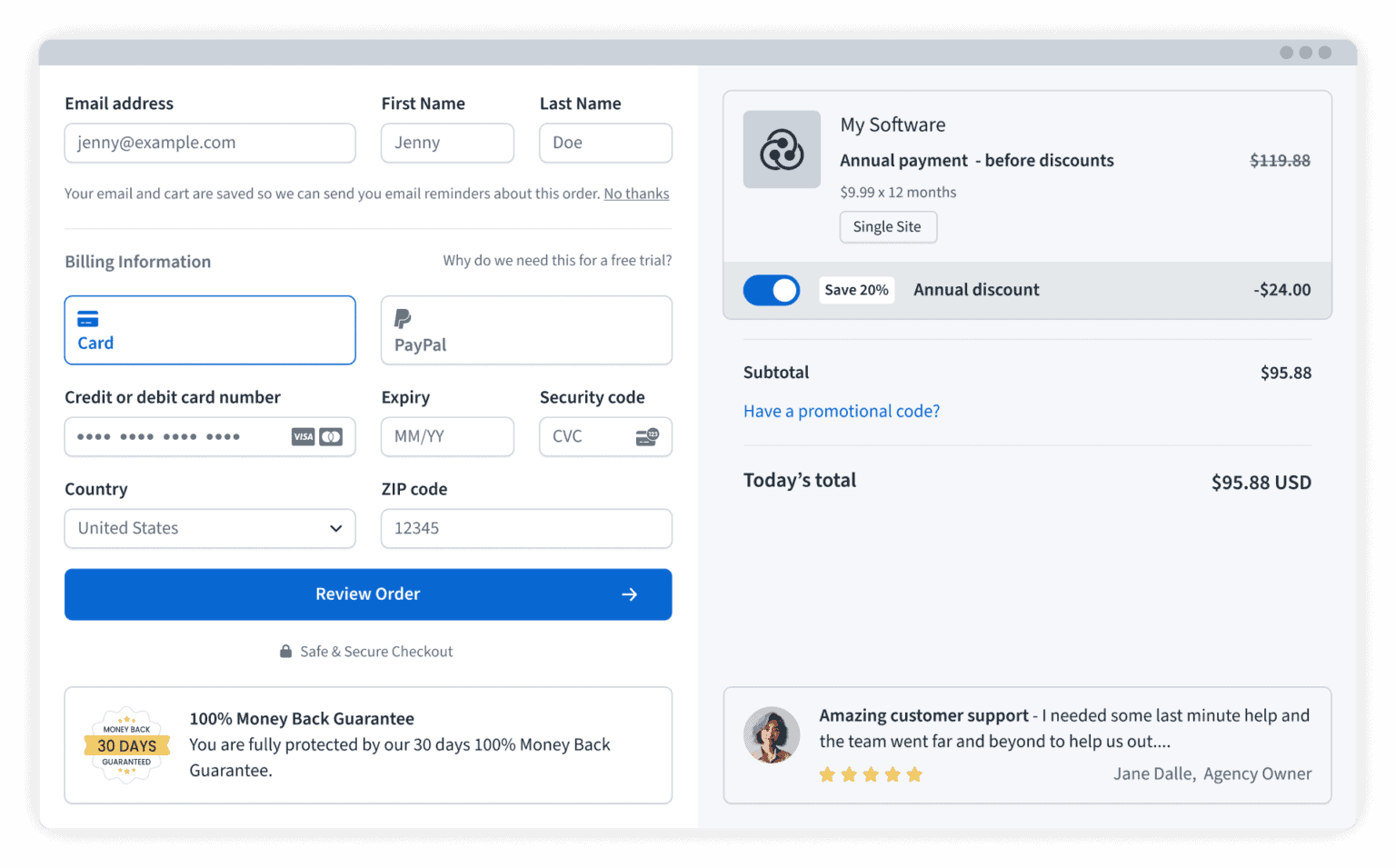
Freemius pricing for AI apps
Freemius uses a progressive revenue share starting at 4.7% for SaaS and app makers. There are no additional fees for subscriptions, currency conversion, PayPal transactions, or affiliate payments, and tax and VAT are excluded from the revenue share calculation.
As you grow, the rate drops, reaching as low as 0.5% on monthly revenue above $100k.
| Monthly revenue | Freemius fee |
| First $50,000 | 4.7% |
| $50,001 – $100,000 | Scales down progressively |
| Over $100,000 | 0.5% |
For builders who choose Stripe without MOR coverage, tax compliance, failed payment recovery, dispute handling, and invoicing all fall on you.
Freemius handles all of that as part of the platform, which matters more as your product grows than it does on day one.
Lovable Payments gets you started — not scaled
Lovable Payments gets you to a working checkout fast. For a simple product, that’s often enough.
But as more users join, pricing evolves, and access becomes more complex, those limitations start to shape how your product works and how far your business can grow.
If you’ve hit those limits, Freemius is one way to move beyond them — feature-based paywalls, a built-in affiliate platform, and full tax coverage as merchant of record.
Lovable Payments helps you start charging. Tools like Freemius help you build a business around it.
Start selling with Freemius or check out the Lovable integration guide to see how it works.
FAQ: Lovable Payments
What is Lovable Payments?
A native monetization layer built into Lovable. You accept subscriptions and one-time payments via Stripe or Paddle — no custom backend required.
Does Lovable Payments support Stripe and Paddle?
Lovable Payments supports three providers: Stripe and Paddle. Stripe and Paddle are built-in providers for digital products and software. When you ask Lovable to add payments, it recommends a provider based on what you are selling. You can only use one provider per project.
How does Lovable Payments work?
You describe what you want to sell via prompt. Lovable sets up your provider account, creates products and pricing, and builds the checkout flow inside your app.
Do you need Stripe or Paddle to use Lovable Payments?
Yes. Lovable Payments relies entirely on Stripe or Paddle to process transactions, handle payments, and manage billing infrastructure.
Is Lovable Payments free?
Lovable Payments is included in Lovable’s paid plans, but you still pay transaction fees through Stripe or Paddle depending on your provider.
Can Lovable Payments handle complex SaaS pricing?
Not natively. More advanced pricing models like usage-based billing, add-ons, or multiple subscriptions per user require additional setup or an external monetization solution.
Before choosing a setup, it’s worth making sure the underlying pricing structure is right for your AI product — inference costs make model choice more consequential than it is for traditional SaaS. Our guide to AI app pricing models covers what works and what struggles under real usage.
Does Lovable Payments support feature-based access or paywalls?
Lovable Payments handles basic subscription logic, but it does not provide built-in feature-level access control or advanced paywall systems.
Is Lovable Payments enough to run a SaaS business?
For simple products, often yes. As your SaaS grows, you may need more control over pricing, access, subscriptions, and compliance than Lovable Payments provides.
When should you move beyond Lovable Payments?
Usually when your product needs more than a simple checkout — for example, multiple subscriptions, feature-based access, or pricing that keeps changing as you grow.
What are the alternatives to Lovable Payments?
The main alternatives are using Stripe or Paddle directly, or adding an external monetization platform like Freemius. Stripe and Paddle give you more direct control but require more setup, while platforms like Freemius add subscription management, feature gating, and global tax handling on top of your existing app.