|
|
Choosing the wrong merchant of record can cost you far more than a higher transaction fee — fund freezes, account limits, surprise compliance issues in your target markets, contracts designed to keep you trapped.
For indie SaaS founders, early-stage software businesses, or plugin/extension developers, every MoR makes tradeoffs across three areas:
- Control over customer data and billing
- Operational burden the platform handles
- Total cost for your sales volume
These tradeoffs guided our search for the best merchant of record for each type of software business, comparing seven platforms on business model fit, global tax coverage, subscription tools, fraud management, and contract terms.
At a glance: Best merchant of record platforms for software makers
- Freemius — best for SaaS, AI apps, desktop software, plugins, themes, and extensions that need billing + licensing + retention in one system
- Paddle — best for scaled SaaS with strong compliance focus and engineering teams
- FastSpring — best for mixed B2B + B2C software with quoting needs
- PayPro Global — best for enterprise and government sales
- Lemon Squeezy — best for simple indie product launches
- Cleverbridge — best for enterprise billing complexity and contracts
- Dodo Payments — best for emerging-market founders needing fast payment access
What a merchant of record actually does (and why it matters for software developers)
A merchant of record (MoR) is the legal entity responsible for selling your product to the end customer. It handles payment processing, tax collection and remittance, fraud, chargebacks, and regulatory compliance, taking on full legal liability for each transaction.
In practice, that means their name is on the receipt, and global tax compliance becomes their problem.
That matters a lot when you’re selling globally.
Without an MoR, you’d need to register for VAT across EU countries. You’d also track US sales tax in over 12,400 jurisdictions, according to Vertex’s 2025 tax data. Plus, you’d manage Digital Services Tax (DST) rules in markets like the UK and France. All while keeping up with constant changes.
Miss something and you’re looking at back taxes, interest, and fines.
With an MoR, you can accept payments from global customers without setting up local legal entities or registering for taxes in every market. The platform handles tax calculation, collection, and remittance, plus payment security standards like PCI-DSS and regulations like GDPR.
The main trade-off is a slight loss of control. Your customers technically buy from the MoR, so their name shows on bank statements, which can occasionally cause confusion when a buyer doesn’t recognize the charge.
You might also have less direct access to some customer payment data compared to using a payment gateway directly.
What to evaluate when choosing a merchant of record
All MoR platforms manage payments and taxes. Here are the criteria we used to compare them:
- Does it fit your business model (e.g., subscriptions, one-time sales, hybrid)?
- Does it manage global taxes (e.g., US sales tax, international VAT/GST)?
- Does it manage fraud and disputes for you, and can you see how?
- Does it help increase customer lifetime value and retain customers (e.g., failed payment recovery, trial-to-paid conversion, upgrades)?
- What are the contract terms (e.g., data export, payout speed, fund freezing conditions)?
Using these criteria, here’s how the seven platforms compare.
| Platform | Business model fit | Pricing | Global tax compliance | Subscription tooling | Licensing support | Retention tooling | Onboarding |
| Freemius | Subscriptions, one-time sales, freemium, hybrid (free + paid tiers), usage-gated trials, modular add-on sales | 4.7% scaling down to 0.5% | EU/UK VAT, US sales tax, reverse charge for B2B | Full | Built-in | Dunning, cart recovery, cancellation flows, win-back; all native, no extra cost | Self-serve, near instant |
| Paddle | Subscriptions, one-time sales, usage-based billing | 5% + $0.50 on gross including tax | 100+ countries; limited US tax-exempt support | Full | Limited | Dunning included; full Retain suite (cancellation flows, term optimization) cost depends on tier | 1–6 week KYC |
| FastSpring | One-time sales, subscriptions, bundled pricing | Negotiated | 1,000+ returns/year; US exemptions, B2B reverse charge | Full | Via third-party integrations | Dunning and renewal flows included; no cancellation flows or win-back | Sales call |
| PayPro Global | Subscriptions, one-time sales, volume licensing | Negotiated | Markets itself as covering 13,000+ tax jurisdictions; US sales tax, VAT/GST | Full | Enterprise-grade | ML Smart Retry for failed payments; no cancellation flows or win-back | Sales call |
| Lemon Squeezy | One-time sales, subscriptions | 5% + $0.50 on gross (+ add-ons) | 130+ countries; nexus handled | Basic | Basic key generation | Basic dunning; cart recovery at extra cost; no cancellation flows | Self-serve |
| Cleverbridge | Subscriptions, multi-year contracts, channel/reseller sales | Negotiated enterprise rates | 240+ markets; US sales tax, VAT, DST | Enterprise-grade | Enterprise-grade | Dunning, renewal quotes, managed retention marketing; ML retry via Adyen | Enterprise |
| Dodo Payments | One-time sales, subscriptions | 4% + $0.40 (+ add-ons) | 150+ jurisdictions; VAT/GST, US sales tax | Standard | Built-in | Dunning + cart recovery (success-based fee) | Self-serve |
1. Freemius — Best for software businesses that want a complete system for selling and managing revenue
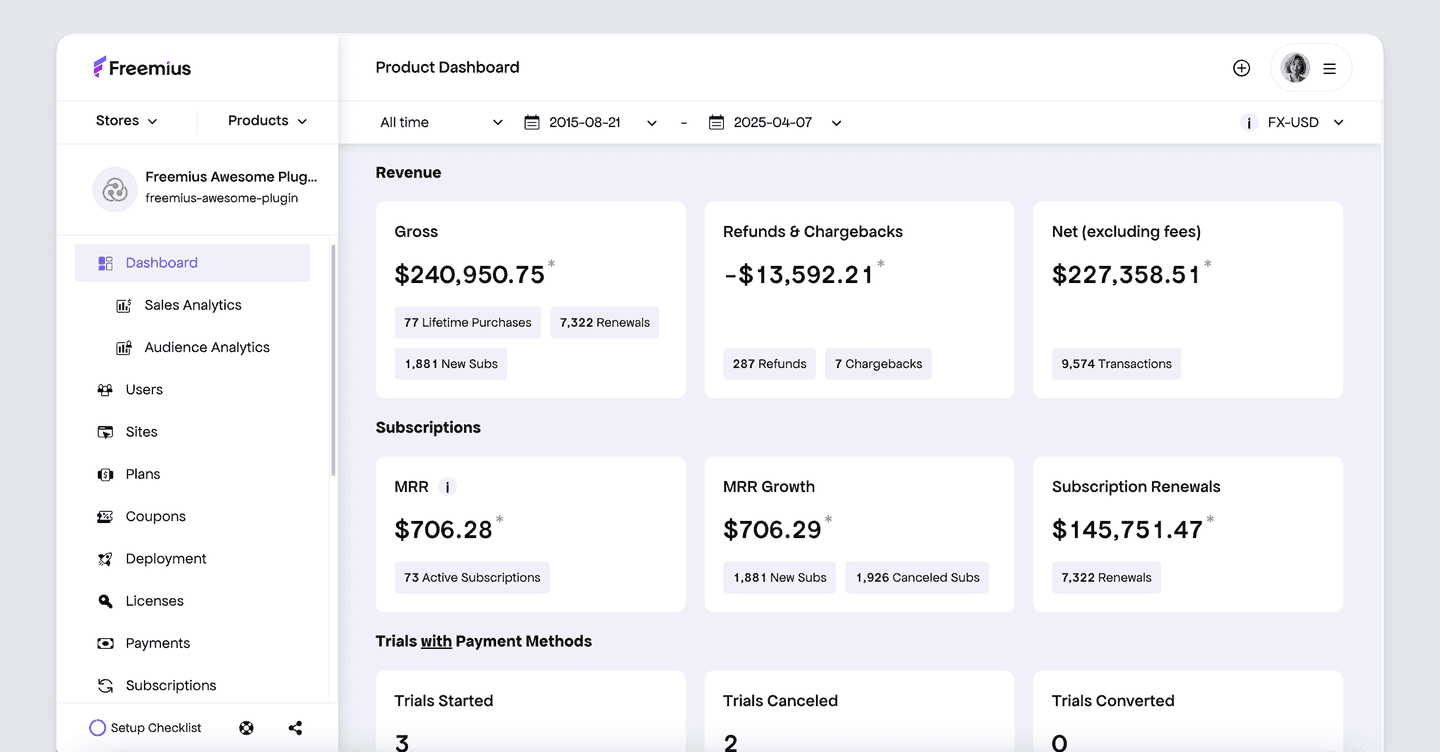
Freemius is a merchant of record built for SaaS, AI products, desktop apps, and WordPress plugins and themes. It combines global tax compliance, payments, subscriptions, licensing, and built-in growth tooling — like upgrade flows, cart abandonment recovery, and affiliate management — into a single platform.
While most platforms focus on handling transactions, Freemius is designed to support the full lifecycle of selling software — from how customers buy, to how subscriptions evolve, to how recurring revenue is retained and expanded over time.
This makes it a strong fit for developers who want to run their entire billing and revenue setup in one place, without stitching together multiple tools.
Best for
- Indie SaaS founders who want billing and payments in one system from day one
- Software businesses planning to scale pricing, subscriptions, and retention over time
- App developers monetizing AI-built apps without a technical background
- Developers who want built-in growth tooling, not just payment processing
- WordPress plugin, desktop app, and extension developers needing built-in licensing alongside payments
Key features
- Checkout: Accepts major cards (via Stripe), PayPal, and iDEAL across multiple currencies. Embeds as an overlay or link with built-in upsells, coupons, and exit-intent offers.
- Software licensing: Manages activation limits, feature gates, and trial rules directly in the dashboard.
- Subscriptions: Supports trials (with/without payment), upgrades, downgrades, proration, annual billing, pauses, and automated retries for failed payments.
- Cart abandonment recovery: Sends automated recovery emails (60 mins, 24 hrs, 3 days) with an average 7.5% revenue lift.
- Payment analytics: Tracks net revenue, MRR, churn, trial-to-paid conversion, and revenue by country in real time, filterable by plan, cycle, license, seats, and currency.
- Global tax compliance: Automates calculation, collection, and remittance of VAT, GST, and US sales tax, including B2B reverse charge for EU business buyers.
- Customer portal: Allows buyers to manage licenses, invoices, and payment details independently.
- Affiliate platform: Tracks referrals, manages commissions, and automates payouts with no extra fee.
- Expert support: Direct access to the Freemius team for technical integration help, billing questions, and strategic guidance.
- Community: Invite-only Slack group of thousands of software makers for sharing pricing strategies, launch feedback, and day-to-day growth advice.
Pricing
Freemius uses a progressive revenue share model, meaning fees decrease as you grow:
| Monthly gross | Platform fee |
| $0–$50,000 | 4.7% |
| $50,001–$60,000 | 4.5% |
| $60,001–$70,000 | 4.0% |
| $70,001–$80,000 | 3.0% |
| $80,001–$90,000 | 2.0% |
| $90,001–$100,000 | 1.0% |
| Over $100,000 | 0.5% |
There are no monthly platform fees or extra charges for affiliates, dunning, or cart abandonment. The fee applies only to product revenue (excluding taxes). Gateway fees (~3.5%) are separate.
If you use some WordPress-specific features, there’s a small additional fee.
Possible limitations
- Less suitable for pure digital download stores without software licensing
- Enterprise invoicing complexity for larger B2B deals may require verification
Instant account approval, 0% fees for the first three months on new migrations.
2. Paddle — Best for established SaaS businesses at scale
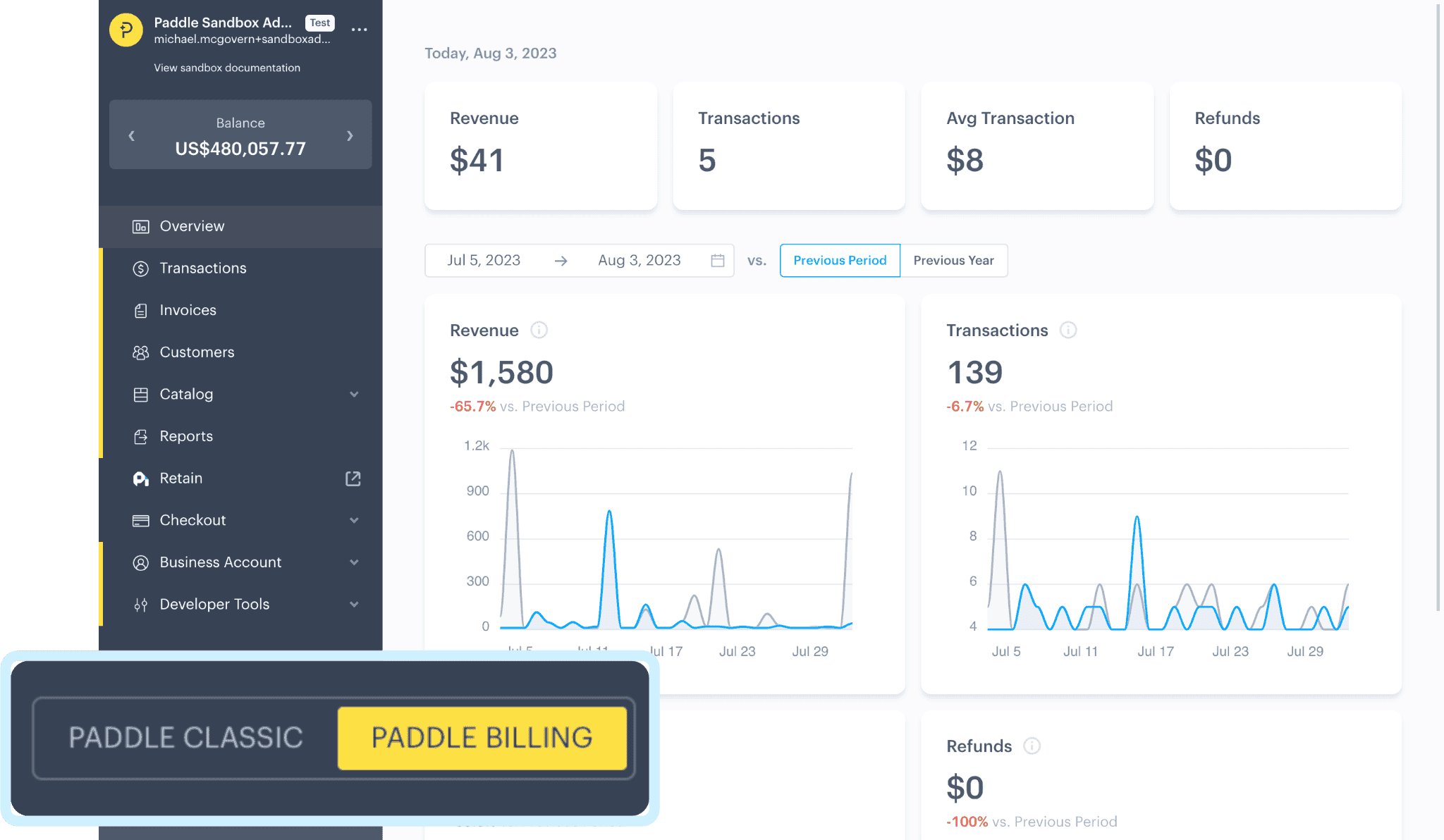
Paddle is the most established merchant of record platform for software companies, processing over $1B annually and backed by $318M. It offers tax remittance, subscription management, checkout, and analytics from a single platform.
While known for its scale and infrastructure, Paddle has become cautious about accepted products, restricting entire categories to manage regulatory risk, a trend tightened by the FTC settlement in June 2025.
It’s good for companies with dedicated engineering teams, solid sales volume, and products that align with Paddle’s acceptable use policy.
Best for
- SaaS companies past the indie phase needing billing infrastructure for larger, funded operations
- Teams with dedicated engineering capacity to build around the Paddle SDK
Key features
- Tax remittance: Calculates, collects, and remits VAT/GST across 100+ countries and US sales tax.
- Subscriptions: Supports trials, upgrades, downgrades, proration, pauses, and automated dunning.
- Checkout: Provides hosted and embedded options with 30+ payment methods, including PayPal, Apple Pay, Google Pay, and more.
- Analytics: Includes ProfitWell Metrics for subscription health, churn analysis, and MRR reporting.
- Cardless trials: Available in developer preview via API; not yet native to Paddle Checkout.
- Fraud prevention: Built-in fraud detection and chargeback handling.
Pricing
- Flat fee: 5% + $0.50 per successful transaction, charged on gross revenue (including tax)*
*For example, on a $20/month EU subscription with 20% VAT, 5% is charged on $24, not $20.
Possible limitations
- Onboarding typically runs two to seven business days for clean SaaS products, but complex categories can take much longer
- Users frequently report support response times of five to 14 days
- Fees charged on gross revenue including tax often mean the effective rate exceeds the advertised 5%
- No native software licensing engine; licensing is limited, inherited from the DevMate acquisition
- Reports of sudden account closures and fund holds, with increasing category restrictions (e.g., generative AI tools) due to compliance scrutiny
- No built-in affiliate platform or cart abandonment recovery without additional cost
See also: Freemius vs. Paddle: Direct comparison for selling software
3. FastSpring — Best for software businesses with mixed B2B and B2C sales
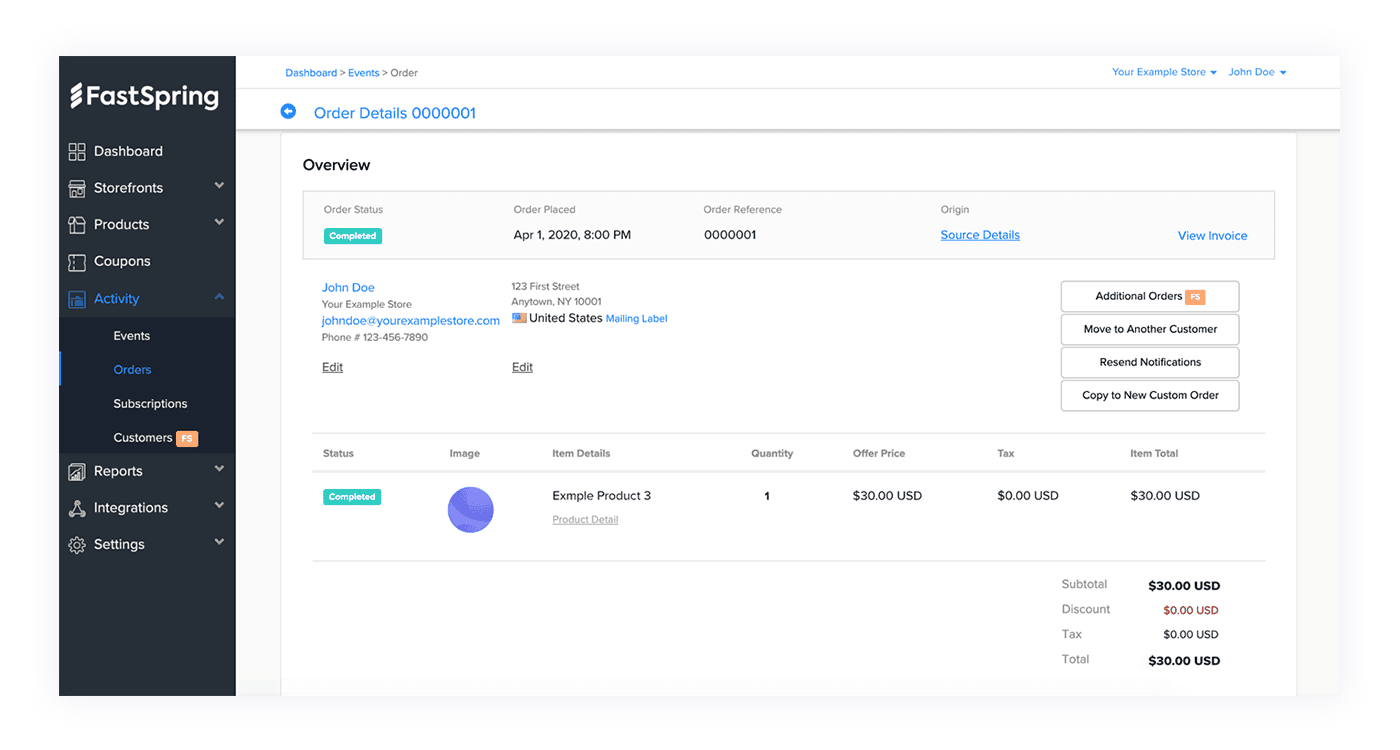
FastSpring simplifies software sales, covering self-serve checkout, sales-assisted B2B deals, and one-time downloads. It manages global tax, subscription billing, and payment processing.
Its key differentiator is the B2B quoting layer, enabling sales teams to send custom pricing pages with tiers, add-ons, eSignatures, and approval workflows, all integrated with FastSpring’s billing system.
This makes it a solid fit for scaling software businesses that use both self-serve and sales-assisted models, consolidating tools to reduce operational complexity.
Best for
- Software companies needing both B2C checkout and B2B custom quotes from one MoR
- ISVs with large international catalogs across multiple product types
Key features
- Tax remittance: Covers major regions (EU, US, Canada, Australia, Japan, India, Singapore, South Korea, Taiwan, Indonesia, Malaysia, Brazil) with ~1,000 annual tax returns. Supports US tax-exemption.
- B2B quoting: Interactive Quotes offer digital quote pages with up to five pricing tiers, add-ons, eSignatures, approval workflows, and HubSpot CRM sync.
- Checkout: Supports major payment methods (Visa, Mastercard, PayPal, Apple Pay, Google Pay, Amazon Pay, Alipay, and more) across 20+ currencies.
- Subscriptions: Includes cardless free trials with Trial Hopping Prevention, dunning, and renewal flows.
Pricing
- Custom rates based on transaction type and volume; no public pricing.
- A $150 annual Risk Screening Fee applies to sellers processing less than $5,000 per year.
Possible limitations
- No self-serve signup; requires a sales conversation, delaying initial transactions
- Negotiated pricing makes cost forecasting and benchmarking difficult without a sales process
- The $150 annual Risk Screening Fee is billed upfront
- Transaction fees are not refunded with customer refunds, incurring a double loss
- Licensing requires third-party integrations, adding setup complexity and external dependencies
- Lacks a built-in affiliate platform, requiring a separate tool for referral programs
- Dashboard often reported as complex and outdated
4. PayPro Global — Best for SaaS businesses selling to enterprises and government buyers
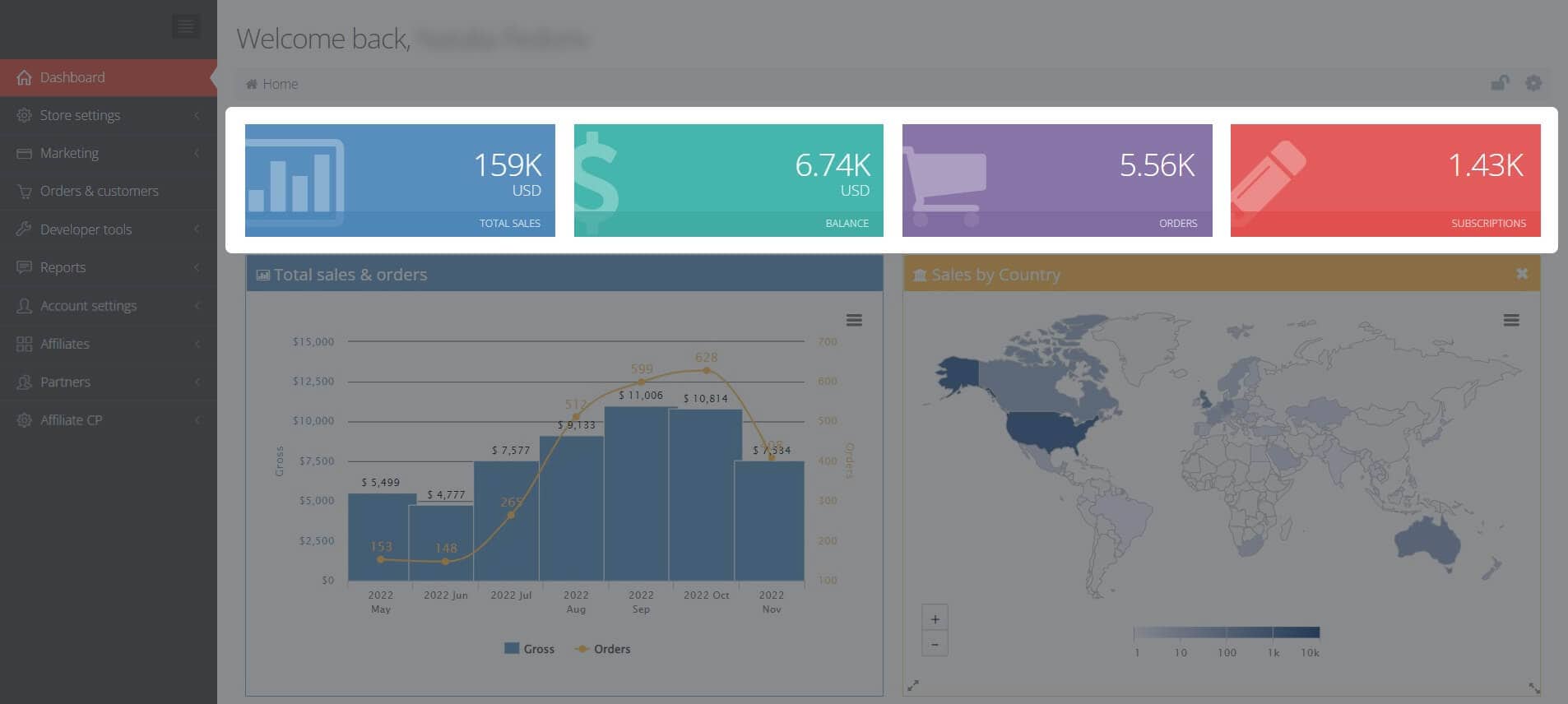
PayPro Global is an MoR platform for selling SaaS, software, and video games globally (200+ countries). It manages global payments (70+ methods, 140+ currencies), tax remittance (13,000+ jurisdictions), subscription management, and fraud prevention.
It stands out for enterprise and government sales, offering W-8/W-9 form generation, government-ready invoicing, and global compliance flows required by public sector procurement.
This makes it a solid option for software businesses needing broad global coverage while selling to enterprise or government buyers.
Best for
- SaaS companies selling to government agencies or regulated enterprises with strict compliance
- Software businesses requiring B2B and B2G invoicing alongside standard subscription billing
Key features
- Tax remittance: Covers 13,000+ tax jurisdictions (US sales tax, VAT/GST), including W-8/W-9 form generation and filing for government contracts.
- Payment methods: Supports 70+ methods across 140+ currencies and 200+ regions.
- Subscriptions: Supports tiered, usage-based, flat-rate, hybrid, and modular billing. Auto-renewal is available for card and PayPal; non-card methods require manual renewal.
- Failed payment recovery: Features ML-based Smart Retry for declined transactions.
- Fraud prevention: Manages the entire chargeback process, disputes, and refunds on the seller’s behalf.
Pricing
- PayPro Global uses a custom quote model. All features are included in one price, obtained by contacting their sales team.
Possible limitations
- Requires a sales conversation to compare costs
- Standard contracts are one-year auto-renewing, limiting flexibility for changing needs or early migration
- No self-serve onboarding; setup is sales-gated, adding lead time before going live
- Lacks a native licensing engine, affiliate platform, or cart abandonment recovery, requiring separate building or sourcing
- Dashboard and checkout customization are consistently flagged as outdated
- No SEPA payout support, affecting European sellers preferring EUR bank transfers
5. Lemon Squeezy — Best for indie developers making their first digital product sales
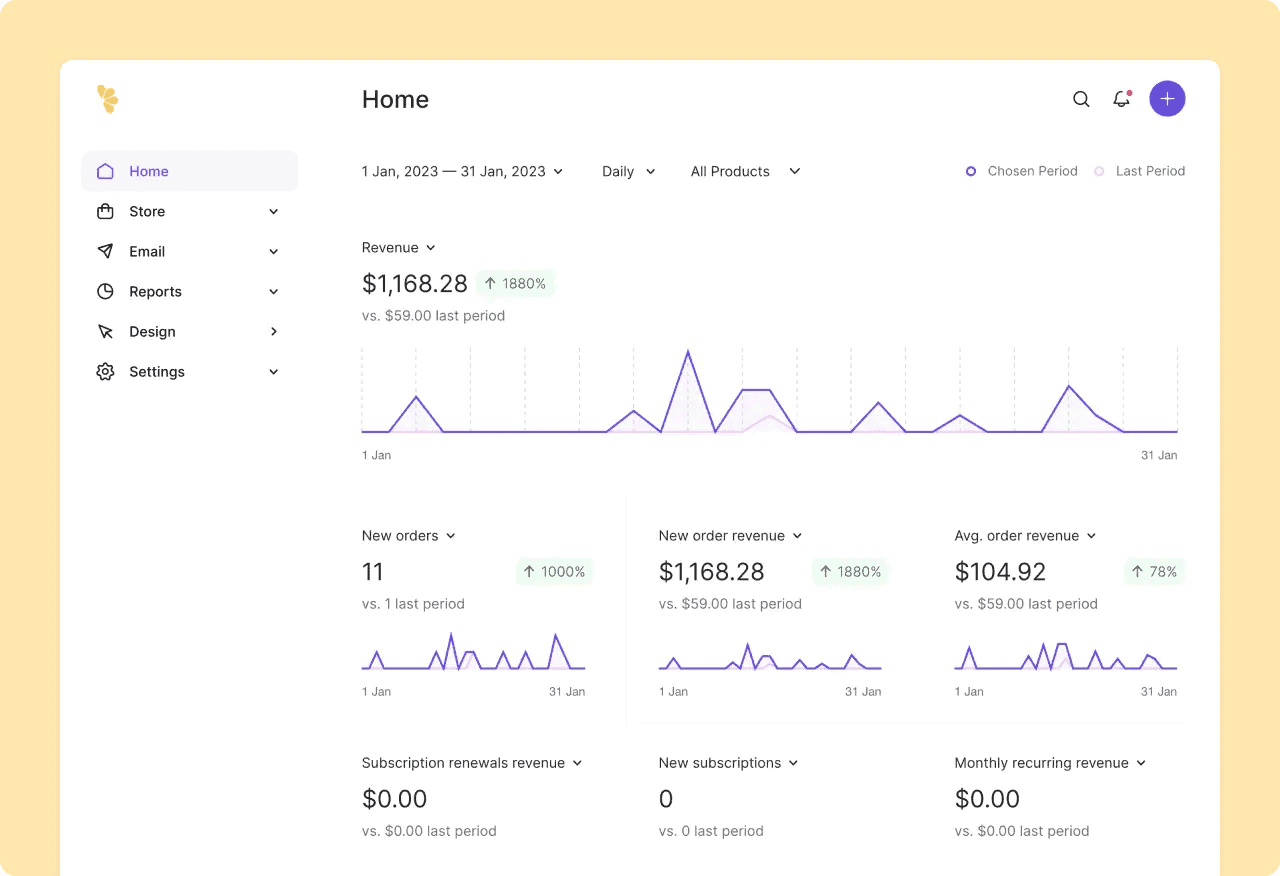
Lemon Squeezy handles payments, tax, and basic subscription billing for software, templates, courses, and memberships. No SDK integration is required.
It’s a broad-category platform, not specifically focused on software. Stripe acquired Lemon Squeezy in 2024 and is developing its own competing MoR product, making its long-term direction uncertain.
It’s a good starting point for solo makers who need to launch quickly without committing to software-specific billing infrastructure.
Best for
- Developers seeking MoR coverage without a software-focused platform
- Small software businesses where complex subscriptions, licensing, and retention aren’t priorities
Key features
- Checkout: Self-serve setup, no mandatory SDK. Accepts cards, PayPal, and local payments.
- Tax remittance: Manages sales tax and VAT in 130+ countries with nexus tracking.
- Licensing: Provides basic license keys tied to subscriptions; validation runs on the seller’s infrastructure.
- Subscriptions: Supports recurring billing and basic subscription flows. Lacks pre-cancellation retention or win-back automation.
- Affiliate tracking: Built-in affiliate tracking included, with additional fees per referral.
Pricing
Lemon Squeezy’s cost varies based on payment mix and features used.
- Flat fee: 5% + $0.50 per transaction on gross revenue (including tax)*.
- Additional charges: International payments (+1.5%), PayPal (+1.5%), subscriptions (+0.5%), cart recovery (+5% per recovered payment), and affiliate referrals (+3% merchant, +2% affiliate). Non-US sellers also pay a 3% payout fee.
*A $20/month EU subscription with 20% VAT means paying 5% on $24, not $20.
Possible limitations
- The 5% + $0.50 base rate increases significantly with international payments, PayPal, subscriptions, and affiliates
- For disputed transactions, Lemon Squeezy auto-refunds, keeps its platform fee, and charges a $15 dispute fee
- Licensing on the seller’s infrastructure adds latency and a maintenance dependency
- Post-Stripe acquisition roadmap is unclear due to Stripe’s competing MoR product
- No pre-cancellation retention or win-back automation for churned subscribers
- Support is ticket-based, lacks strategic guidance, and has inconsistent quality and speed
See also: Freemius vs. Lemon Squeezy: Direct comparison for selling software
6. Cleverbridge — Best for enterprise SaaS teams that need complete control over complex global billing
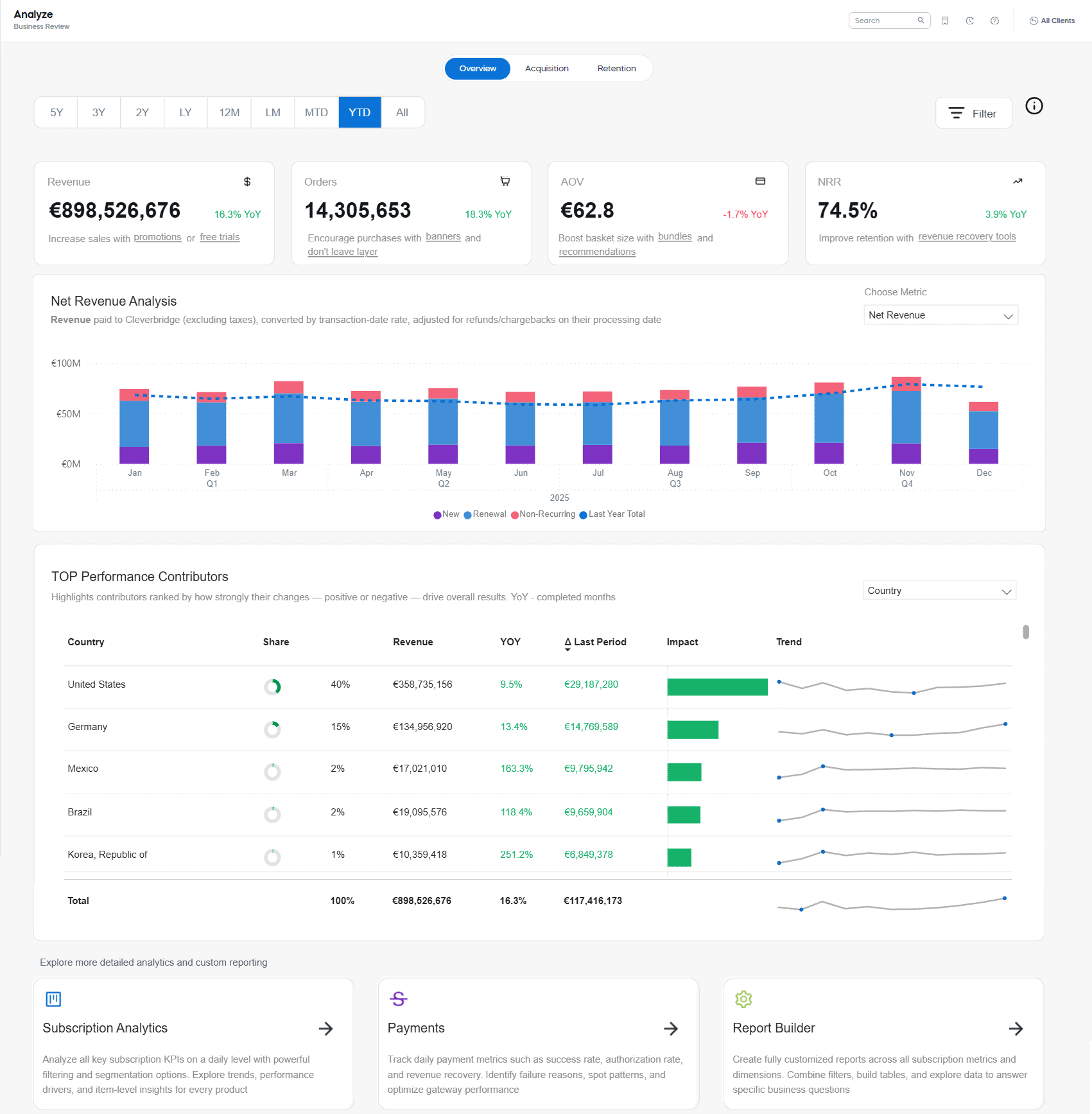
Cleverbridge is built for enterprise software companies requiring advanced billing features beyond standard merchant of record (MoR) services, such as co-term contracts, purchase orders, wire transfers, payment installments, and dedicated account support.
It also offers a hybrid model, allowing companies to retain seller-of-record status while using Cleverbridge as a payment service provider. This helps maintain complete control over customer relationships while offloading payment complexities.
This makes it a fit for mature software businesses with complex B2B billing needs.
Best for
- Enterprise SaaS teams managing complex B2B billing (co-term contracts, purchase orders, multi-currency invoicing)
- Software companies needing dedicated account support alongside MoR infrastructure
Key features
- Subscriptions: Supports co-term contracts, proration, mid-cycle seat additions, and complex renewal flows, including automated quotes and retention marketing.
- Enterprise invoicing: Handles online/offline purchase orders, Net-30 terms, proforma invoices, localized tax invoices, and payment installments for B2B orders over $1,000.
- Failed payment recovery: Uses a Dynamic Retries ML engine, Account Updater, and multi-acquirer rerouting (via Adyen) to retry declined transactions.
- Tax remittance: Covers VAT, GST, US sales tax, and digital services taxes in over 240 markets in MoR mode.
- Engagement models: Offers full MoR or Cleverbridge Service Provider (cSP) mode, where the client remains the seller-of-record.
- Partner network: Integrates with CleverPartners and PartnerStack for B2B channel and affiliate management.
Pricing
Custom, transaction-based rates vary by volume, payment mix, currencies, and customer locations.
Possible limitations
- Most checkout/storefront changes require Cleverbridge staff, tying update turnaround to their availability
- Onboarding involves Cleverbridge’s implementation process, adding lead time before launch
- Upon leaving, Cleverbridge can withhold an amount equal to the last six months of chargebacks/refunds until wind-down is complete (doubled if leaving within the first six months)
- No native software licensing engine or cart abandonment recovery
- UI is often flagged as outdated and difficult to navigate
7. Dodo Payments — Best for founders navigating local payment constraints in emerging markets
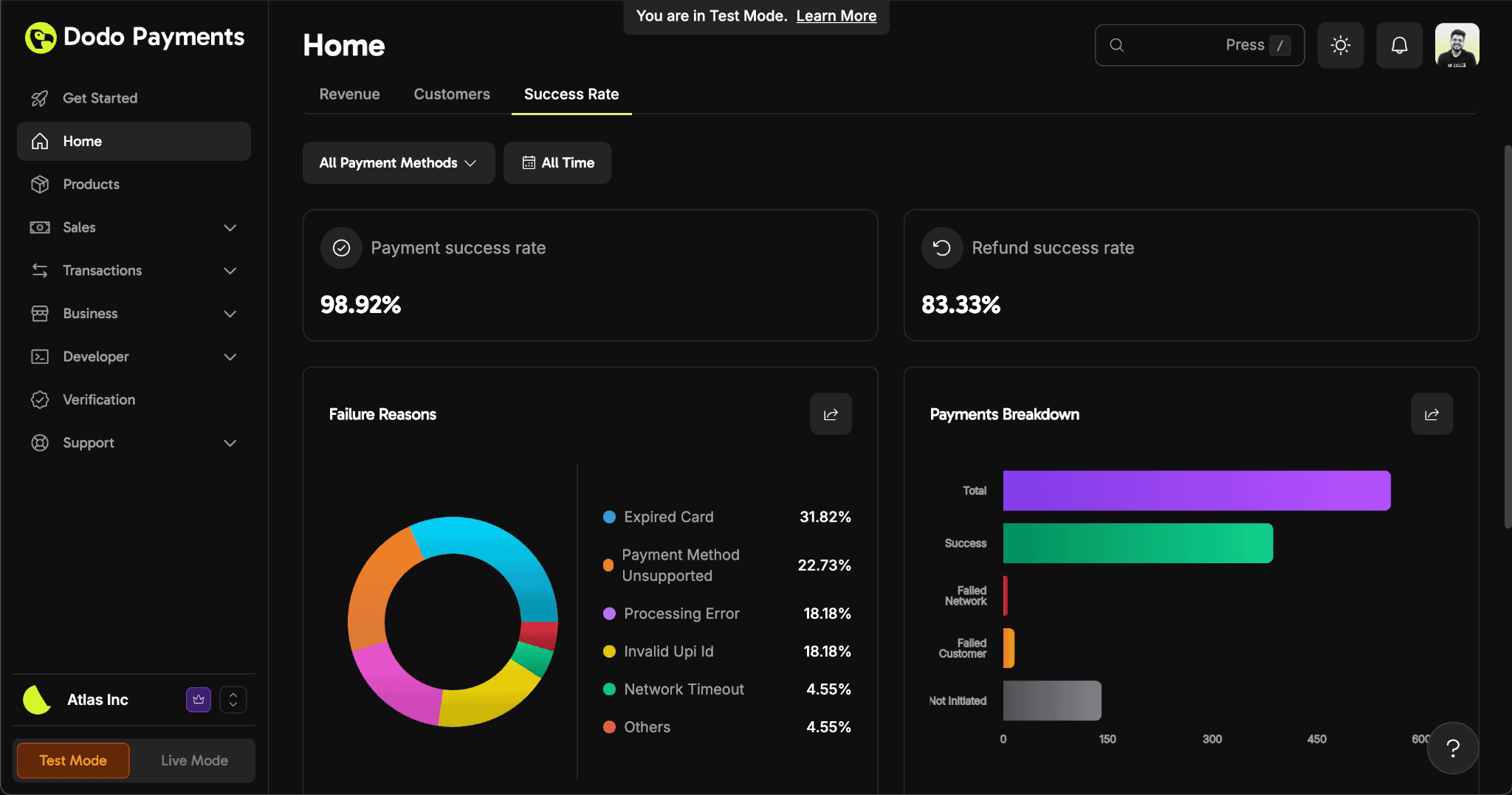
Dodo Payments enables founders in emerging markets to accept global payments even when they can’t easily access other providers due to entity, compliance, or KYC requirements.
It handles payments, tax, fraud, and disputes as a merchant of record, and also supports core SaaS billing needs such as subscriptions (trials, proration, upgrades/downgrades, dunning), licensing, and basic recovery tooling.
This makes it a practical option for founders who need to both gain access to global payments and run standard SaaS billing in one place, particularly at early stages.
Best for
- Founders who are blocked from setting up global payments due to location or entity constraints
- Early-stage SaaS or digital products that need standard subscription billing alongside payment access
Key features
- Global payments: Supports cards, wallets, BNPL, and 30+ local payment methods (including UPI, PIX, SEPA, and regional wallets).
- Tax remittance: Handles VAT, GST, and US sales tax across 150+ jurisdictions with automated invoicing.
- Subscriptions: Supports trials, proration, upgrades/downgrades, dunning, and lifecycle webhooks.
- Licensing: Built-in license key generation, validation APIs, activation limits, and automatic revocation on refund.
- Fraud and disputes: Real-time fraud detection and full chargeback handling, including Visa RDR auto-resolution for low-value disputes.
- Recovery tooling: Cart abandonment and failed payment recovery included, with fees applied only to recovered revenue.
- Checkout: Hosted links, embedded checkout, and SDK-based integrations for web apps and no-code tools.
Pricing
- Flat fee: 4% + $0.40 per transaction.
- Additional charges: International cards (+1.5%), subscriptions (+0.5%), and BNPL methods (+3%). Refunds are charged at $1 per refund, and chargebacks at $30 per dispute.
Possible limitations
- Strict acceptable use policy excludes services, agencies, marketplaces, and several high-risk categories
- Reports of account suspensions and fund holds (up to 120 days) tied to compliance reviews
- Less mature platform compared to established MoRs, with a shorter track record
- Customer support is primarily ticket-based, with slower response times on compliance issues
- Offers less depth in subscription optimization, retention tooling, and revenue analytics
How to choose the right merchant of record for global sales
To select the right MoR, prioritize your product type, evaluate true costs, and review contract terms.
1. Match your product type
Your product type is the primary factor.
- SaaS/recurring subscriptions: Freemius, Paddle, FastSpring
- WordPress plugins/themes: Freemius
- AI apps: Freemius (integrates with Lovable)
- B2B software (sales-assisted): FastSpring, Cleverbridge
- Government/procurement contracts: PayPro Global
- Mixed digital goods: Lemon Squeezy
- Emerging-market SaaS: Dodo Payments
2. Evaluate the true cost
Beyond headline rates, ask:
- Are fees charged on gross revenue (including tax) or net?
- Are fees refunded when you refund a customer?
- What add-ons cost extra (e.g., affiliates, dunning, cart recovery)?
- Are there fees for currency conversion or international payouts?
3. Review contract terms
Before signing with any MoR, check:
- Restricted product categories
- Conditions for fund freezes
- Handling of customer payment data if you leave
Which merchant of record is best for your situation
The right choice depends on what you’re building, how complex your billing needs are, and how much you’re willing to manage yourself.
Choose Freemius if:
- You’re building SaaS, a desktop app, an AI product, or a WordPress plugin, and want a single platform for billing, licensing, tax, and retention
- You want a merchant of record that automatically handles global taxes (e.g., EU VAT, US sales tax, B2B reverse charge)
- You need more than payments infrastructure: affiliate programs, failed payment recovery, upgrade flows, and a customer portal
- You prefer pricing that scales down as your revenue grows
- You want a platform that grows with you as you scale globally
Choose Paddle if:
- You’re an established software business past $100K MRR with dedicated engineering capacity
- Your product fits Paddle’s acceptable use policy cleanly — no gray areas
- You’re okay with a longer onboarding process and separate add-on costs for affiliates and churn recovery
Choose FastSpring if:
- You sell B2B software and need both self-serve checkout and sales-assisted quoting from one platform
- Your ARPU is high enough to absorb negotiated rates and the annual Risk Screening Fee
Choose PayPro Global if:
- You’re selling into government agencies or regulated enterprise buyers that require W-8/W-9 forms and procurement-ready invoicing
Choose Lemon Squeezy if:
- You’re making your first sales and want to get started quickly without a long onboarding
- You’re not yet relying on subscriptions, affiliates, or global expansion for most of your revenue
Choose Cleverbridge if:
- You’re at enterprise scale and need co-term contracts, purchase order workflows, and a dedicated account team
Choose Dodo Payments if:
- You can’t easily use other providers due to location or entity constraints
- Your product is a simple SaaS or digital product without complex billing needs
Start selling your software globally today
Every platform on this list makes trade-offs — on price, flexibility, support, or the categories they’re willing to accept.
But if you’re building software and you want a platform that was designed for exactly that — not enterprise SaaS, not digital creators, but software makers — Freemius is the one place where billing, licensing, tax handling, affiliates, and retention are all handled without duct tape.
And if you’re not sure yet, you can start for free and see for yourself.
FAQ – Best MoR providers
What is a merchant of record?
A merchant of record (MoR) is the legal entity responsible for customer transactions, including tax collection, remittance, and regulatory compliance. The MoR acts as the seller on customer receipts, taking on tax liability, fraud risk, and compliance burdens. They technically buy your product and resell it, assuming full legal responsibility in all selling jurisdictions.
Are all merchant of record platforms the same?
No, they aren’t. While they appear similar due to shared features (payments, tax, subscriptions), merchant of record providers differ significantly in how they support billing models, global expansion, customer retention, and operational complexity. One platform might manage global tax in 240 markets but lack a built-in licensing system. Another could have excellent subscription tools but ban certain product types.
How do I choose the right merchant of record?
Choosing the right MoR is less about rankings and more about fit, scalability, and long-term operational risk. Start with your product type (e.g., SaaS, plugins, AI apps, games), as platforms often specialize. Next, examine how fees accumulate based on your actual revenue, not just the advertised rate. Finally, carefully read the contract, paying attention to acceptable use, fund holding, and data portability clauses.
What are the most common mistakes when choosing an MoR?
The two most common pitfalls are underestimating the work required to scale a platform and overestimating its support for complex billing. A platform that works well at $5K/month might struggle at $100K/month, particularly with subscription flexibility, enterprise invoicing, or customer data portability. Evaluate platforms based on your future needs, not just your current ones.
How is a merchant of record different from a payment gateway?
A payment gateway (e.g., Stripe) processes payments but leaves global tax compliance, fraud, and dispute management to you. A merchant of record takes on those responsibilities entirely. An MoR typically charges higher fees (often 5%–8% per transaction) compared to a DIY stack using a payment gateway like Stripe (which is generally ~2.9% + $0.30).
For businesses expanding globally, an MoR eliminates the need to set up local legal entities or register for sales tax and VAT in every new market. For businesses at low volume, the compliance burden of going direct often costs more in time and risk than the fee difference. As you scale into new international markets, that math shifts, and the right choice depends on your revenue stage and the complexity of your global sales.
What does a merchant of record handle that a payment gateway doesn’t?
Beyond payment processing, an MoR handles:
- Global tax compliance (calculating, collecting, remitting sales tax, VAT, GST)
- Fraud prevention
- Chargeback management
- PCI-DSS compliance
- Ensuring transactions meet local/international regulations (e.g., GDPR)
Essentially, a gateway handles the payment, while an MoR manages the legal and compliance aspects surrounding it.
Can an MoR improve my conversion rates?
Yes. An MoR can improve conversion rates by offering optimized, localized checkout experiences, including preferred local payment methods (e.g., SEPA in Germany, Pix in Brazil, UPI in India), reducing friction without requiring you to build these integrations. For businesses focused on international expansion, this alone can meaningfully impact conversion without adding engineering overhead.
Which merchant of record is best for SaaS?
- Early-stage/indie SaaS: Freemius handles billing, licensing, tax, and retention without sales calls.
- Growth-stage SaaS ($100K+ MRR): Paddle is a popular choice, subject to category fit.
- B2B SaaS with sales-assisted deals: FastSpring’s Interactive Quotes tooling is a strong option.
Which merchant of record is best for WordPress plugins?
Freemius is the only MoR specifically designed for WordPress plugin and theme distribution, managing licensing, automatic updates, feature gating, and subscription billing via a single SDK.
How much does a merchant of record cost?
MoR providers typically charge fees ranging from 5% to 8% of each transaction. Pricing models vary: some use flat rates based on transaction type and volume, while others offer percentage-based pricing that adjusts with transaction volume, payment mix, and customer locations.
Total costs can also include hidden charges for chargebacks, international payments, and setup fees.
What should I check in an MoR contract before signing?
Focus on these four points:
- The acceptable use policy (restricted product categories)
- Conditions for holding funds or closing accounts
- What happens to your customer data if you migrate
- Payout timing, including any new-account holding periods
These are the contract terms most likely to create compliance exposure down the line and the ones least likely to be surfaced during a sales conversation.